Introduction
In a world filled with complex recipes demanding hours in the kitchen and endless lists of ingredients, there exists a delightful exception that captures the essence of simplicity and pure joy: the two-ingredient coconut candy. This humble treat, made solely from sweetened condensed milk and dried coconut flakes, transforms basic pantry staples into soft, chewy bites of tropical indulgence that melt in your mouth with every nibble. Its allure lies not just in its effortless preparation but in the way it evokes nostalgia, comfort, and celebration across cultures worldwide. Whether rolled into perfect spheres, pressed into festive shapes, or enjoyed straight from the tray, these candies offer a symphony of creamy sweetness balanced by the nutty, fibrous texture of coconut. They are the perfect embodiment of “less is more,” proving that profound deliciousness can emerge from the most minimal combinations. As we dive into this comprehensive exploration, you’ll discover how this unassuming recipe has woven itself into the fabric of global sweets traditions, delighting generations with its versatility and irresistible charm.
This candy’s magic begins with the harmonious marriage of condensed milk’s rich, caramel-like depth and coconut’s natural fragrance and subtle crunch. The result is a confection that feels both luxurious and homemade, evoking memories of childhood treats, holiday gatherings, and spontaneous kitchen experiments. Unlike elaborate desserts that require precision and patience, this recipe invites everyone—novices, busy parents, and seasoned bakers alike—to create something extraordinary in mere minutes. It’s a testament to resourceful cooking, born from necessity yet elevated to an art form in various cultures. From Brazilian festas to Indian festivals and beyond, these coconut delights symbolize affection, abundance, and shared happiness. In the pages ahead, we’ll uncover their origins, cultural significance, precise ingredients, creative additions, expert tips, step-by-step instructions, sensory descriptions, nutritional insights, and why they deserve a place in your repertoire of healthful indulgences.
What makes this two-ingredient wonder so universally appealing is its adaptability to personal tastes and dietary preferences. Opt for sweetened or unsweetened coconut to control the sweetness level, or experiment with shapes and coatings for visual flair. It’s gluten-free by nature, requires no baking, and stores beautifully, making it ideal for gifting or last-minute cravings. As we celebrate this timeless treat, prepare to be inspired not only to make it but to embrace its spirit of joyful simplicity in your own culinary adventures.
Origin
The origins of coconut candy made with condensed milk trace back to a fascinating interplay of colonial history, tropical abundance, and industrial innovation. Coconut-based sweets have ancient roots in regions where palm trees thrive, from Southeast Asia and the Pacific Islands to Latin America and the Caribbean. Indigenous peoples long utilized coconut’s versatile meat, milk, and sugar to create chewy confections, often boiled with local sweeteners like palm sugar or cane syrup. However, the specific two-ingredient version we know today—relying on sweetened condensed milk—emerged in the 20th century, propelled by the invention and global spread of canned condensed milk.
Sweetened condensed milk was patented in the mid-19th century by Gail Borden as a preservation method for milk, but its widespread use in sweets exploded in the early 20th century, particularly in tropical countries where fresh milk spoiled quickly. Brands like Nestlé marketed it aggressively in Latin America and Asia, revolutionizing home cooking. In Brazil, this led to the modern form of beijinho de coco (literally “little coconut kiss”), a staple at birthday parties alongside its chocolate cousin, brigadeiro. Historical accounts suggest beijinho evolved from Portuguese “beijos” (kisses), almond-based sweets brought during colonization, which Brazilians adapted by substituting abundant coconut. By the mid-20th century, condensed milk replaced traditional milk-and-sugar reductions, simplifying the process while enhancing creaminess. Often topped with a single clove for decoration, beijinho symbolizes tenderness and is one of Brazil’s most iconic doces (sweets).
Across the ocean in India, a parallel evolution occurred with coconut ladoo or nariyal ke laddu. Traditional ladoos date back centuries, made with fresh coconut, jaggery, or sugar syrup for festivals like Diwali and Ganesh Chaturthi. The condensed milk variant gained popularity in the mid-20th century as Milkmaid (Nestlé’s brand in India) became a household staple. This quick version bypassed lengthy syrup-making, allowing home cooks to whip up festive treats rapidly. It’s now a beloved shortcut for modern Indian households, retaining the auspicious round shape symbolizing completeness and prosperity.
Similar adaptations appear elsewhere: in Mexico as simplified cocadas, chewy coconut candies sold in markets; in the Philippines and Vietnam as coconut jams or balls; and even in Caribbean and African traditions where coconut and sweetened milk create portable treats. The two-ingredient recipe’s purity—often without added butter or flavorings—represents a minimalist adaptation, popularized through online sharing and global migration. Today, it’s a cross-cultural phenomenon, bridging continents through shared love of coconut’s tropical bounty and condensed milk’s convenient richness.
Cultural Significance
Beyond its delicious taste, this simple coconut candy holds profound cultural significance in numerous societies, often embodying themes of love, celebration, and community. In Brazil, beijinho is inseparable from festas juninas (June festivals) and children’s birthday parties, where trays of brigadeiros and beijinhos in colorful paper liners signify abundance and joy. The name “little kiss” reflects its affectionate role—offered as tokens of endearment. Traditionally garnished with a clove (cravo), it adds an aromatic touch while evoking colonial influences. These sweets democratize indulgence; even in modest homes, condensed milk allows everyone to partake in festive sweetness.
In India, coconut ladoo carries spiritual weight during religious observances. Coconut symbolizes purity and fertility in Hindu traditions, offered to deities as prasad (blessed food). Round ladoos represent wholeness and good fortune, distributed during Diwali (festival of lights), Raksha Bandhan (sibling bond), or weddings. The condensed milk version modernizes ancient recipes, making it accessible for urban families while preserving ritual importance. It’s a gesture of hospitality, shared with neighbors and guests to foster bonds.
Globally, variations underscore coconut’s role in tropical cultures as a life-sustaining ingredient. In Latin America, cocadas street vendors sell evoke everyday resilience and street food heritage. In Southeast Asia, similar treats wrapped in banana leaves highlight communal feasting. The recipe’s simplicity resonates in diaspora communities, where immigrants recreate homeland flavors with limited ingredients, passing traditions to new generations. In contemporary contexts, it’s embraced for its vegan potential (using coconut condensed milk) and gluten-free nature, fitting modern wellness trends while honoring roots.
Ultimately, this candy transcends mere dessert—it’s a vessel for cultural memory, familial love, and festive spirit, reminding us how food connects us across borders and time.
Ingredients Quantity
At the heart of this enchanting candy are just two essential ingredients, carefully balanced for perfect texture and flavor. The standard recipe yields approximately 20-25 small balls, depending on size.
- Sweetened Condensed Milk: 395 grams (one standard 14-ounce can or box). This provides the creamy binding, richness, and primary sweetness. Use full-fat for best results; low-fat versions may yield a less cohesive mixture.
- Dried Coconut Flakes (Desiccated Coconut): 200 grams. Choose finely shredded for smoother balls. Sweetened flakes intensify the candy’s sweetness, ideal for those with a strong sweet tooth, while unsweetened offers a more subtle, natural coconut flavor with balanced richness from the condensed milk.
These precise quantities ensure the mixture thickens properly during cooking without becoming overly sticky or dry. Scaling up is straightforward—maintain the ratio of roughly 2 parts condensed milk to 1 part coconut by weight for consistency.
Optional Additions
While the beauty of this recipe lies in its minimalism, optional additions can elevate flavors, textures, and visuals without complicating the process.
Common enhancements include a tablespoon of unsalted butter for extra silkiness (a nod to traditional Brazilian beijinho), or a dash of vanilla extract/cardamom powder for aromatic depth. In Indian variations, ground cardamom or saffron strands infuse festive warmth. For crunch, fold in chopped nuts like pistachios, almonds, or cashews during mixing.
Creative twists: Add cocoa powder for chocolate-coconut fusion, or rose water/gulkand for floral notes in ladoo-style versions. Toppings vary culturally—roll in extra coconut flakes, granulated sugar, or cocoa; garnish with cloves (Brazilian tradition) or edible silver leaf (Indian elegance).
For healthier spins, use coconut-based condensed milk for vegan/dairy-free, or incorporate seeds like chia for added nutrition. These additions keep the spirit of simplicity alive while personalizing your creation.
Tips for Success
Achieving perfect coconut candy requires attention to a few key details, ensuring fudgy texture and easy handling.
First, use a heavy-bottomed non-stick saucepan to prevent scorching—constant stirring is crucial as the mixture thickens. Cook on medium heat; rushing with high flame risks burning. The endpoint is when the mixture pulls away cleanly from the pan sides, forming a soft dough (about 8-12 minutes).
Allow slight cooling before shaping; too hot, and balls won’t hold; too cool, and they’ll crack. Grease hands lightly with butter or oil for smooth rolling. For uniform sizes, use a small cookie scoop.
Storage tips: Keep in an airtight container at room temperature for up to a week, or refrigerate for longer shelf life (up to 2 weeks). Bring to room temp before serving for soft texture.
Troubleshooting: If too sticky, cook longer or add more coconut; if dry, incorporate a splash of milk. Experiment with coconut fineness—finer shreds yield creamier results.
Safety note: Supervise children during cooking, as the mixture gets very hot.
Instructions
Follow these detailed steps for foolproof results.
Step 1: Mix
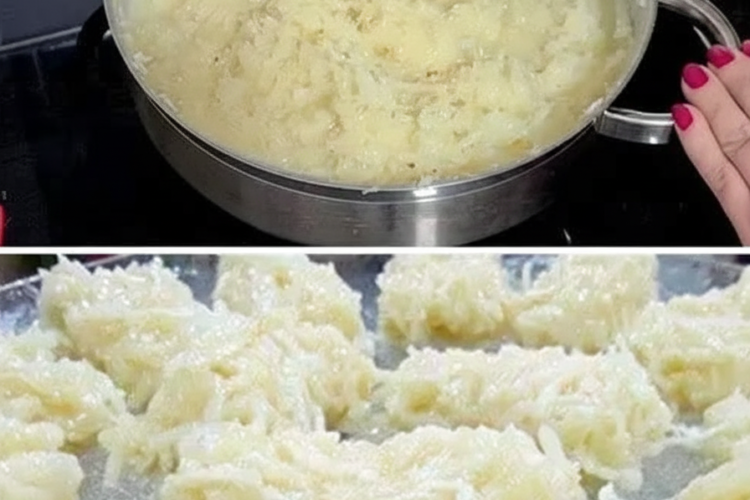
In a medium non-stick saucepan, combine the 395g sweetened condensed milk and 200g dried coconut flakes. Stir thoroughly over low heat until the coconut is fully coated and the mixture is uniform. This initial blending ensures even cooking and flavor distribution.
Step 2: Cook
Increase to medium-high heat. Stir continuously with a wooden spoon or spatula, scraping the bottom and sides to prevent sticking or burning. Cook for 8-10 minutes until the mixture thickens significantly, darkens slightly, and begins to pull away from the pan, forming a cohesive mass. It should feel like soft dough when tested.
Step 3: Shape
Remove from heat and let cool for 10-15 minutes until warm but handleable. Grease your hands lightly. Scoop tablespoon-sized portions and roll into smooth balls, or press into silicone molds for hearts, stars, or other shapes. For traditional flair, insert a clove into each ball or roll in extra coconut.
Step 4: Cool
Place shaped candies on a parchment-lined tray. Allow to set at room temperature for 30-60 minutes until firm. For faster setting, refrigerate briefly.
Step 5: Enjoy
Transfer to a serving platter or store in an airtight container. These are best enjoyed fresh but improve in flavor after a day as textures meld.
Yield: 20-25 pieces. Total time: About 30 minutes active, plus cooling.
Description
These two-ingredient coconut candies are a sensory delight: visually appealing round bites dusted in snowy coconut flakes, evoking tropical snowballs or festive ornaments. Their exterior offers a subtle crunch from the flakes, yielding to an interior that’s irresistibly soft, fudgy, and chewy—like a cross between caramel and macaroon.
The flavor profile is pure coconut bliss: intensely aromatic and nutty, with creamy sweetness from condensed milk that lingers without overwhelming. Each bite releases waves of tropical fragrance, balanced by the milk’s subtle caramel notes. Texture-wise, they’re melt-in-your-mouth tender yet substantial, perfect for savoring slowly.
Culturally adorned—cloves for Brazilian elegance or nuts for Indian crunch—they’re versatile crowd-pleasers, evoking warmth and nostalgia in every mouthful.
Nutritional Information
This candy, while indulgent, derives benefits from coconut’s natural properties. Per typical serving (one 20g ball, from the recipe yielding ~25 pieces):
- Calories: Approximately 90-110 kcal
- Carbohydrates: 10-12g (mostly sugars from condensed milk)
- Fat: 5-7g (primarily saturated from coconut, including medium-chain triglycerides—MCTs—known for quick energy)
- Protein: 1-2g
- Fiber: 1g (from coconut, aiding digestion)
- Other: Small amounts of iron, manganese, and potassium from coconut.
It’s naturally gluten-free and can be dairy-free with coconut condensed milk. High in energy but calorie-dense, enjoy in moderation. Coconut’s fats support metabolism, while fiber promotes satiety. Not low-sugar, but a better-for-you treat compared to processed candies.
(Values approximate; vary by coconut type and exact portions.)
Conclusion
As we wrap up this journey through the world of two-ingredient coconut candy, it’s clear this simple creation is far more than a quick sweet—it’s a bridge to heritage, a spark of creativity, and a reminder of life’s sweetest simplicities. From its humble origins in tropical ingenuity to its cherished place on festive tables worldwide, this treat encapsulates joy in every bite.
Whether you’ve followed the classic recipe or added your twist, these candies invite us to slow down, savor, and share. They’ve endured because they deliver profound pleasure with minimal effort, proving elegance often lies in restraint.
Recommendation
I wholeheartedly recommend making this candy your go-to for holidays, gifts, or everyday treats. Start with the basic version to appreciate its purity, then experiment—perhaps chocolate-dipped for decadence or nut-studded for texture. It’s ideal for involving kids in the kitchen, teaching them the magic of transformation.
Pair with coffee, tea, or as party favors. For special occasions, present in decorative boxes tied with ribbon. It’s versatile, forgiving, and always impressive.
Embracing Healthful Indulgence
In an era of restrictive diets, this coconut candy champions mindful indulgence. Coconut’s MCTs provide sustained energy without crashes, while its fiber and minerals nourish subtly. By choosing quality ingredients—perhaps organic coconut or reduced-sugar condensed milk—you elevate it to a guilt-free pleasure.
Treat it as occasional delight: one or two pieces satisfy cravings healthily. It’s proof that sweetness and wellness coexist, encouraging balanced enjoyment over deprivation. Embrace this treat as part of a vibrant, joyful approach to eating—where tradition meets nourishment, and every bite celebrates life’s flavorful abundance.