:max_bytes(150000):strip_icc():format(webp)/MS-870547-olive-and-cheese-loaf-hero-3x2-4575-b4c29e10aa6c4f54abedc83bac4ea98f.jpg)
How No-Knead Bread Recipes Work
Whether you’re intimidated by bread baking or just short on time, no-knead recipes are an ideal way to get a homemade loaf on the table with little effort. Even better, they often even have a more complex flavor and better chewiness than breads that are kneaded and baked within a few hours.
The secret to no-knead bread lies in a hefty amount of both time and moisture. Let’s start with time: Kneading is useful for producing gluten, the elastic network of proteins—glutenin and gliadin—that forms when flour and water are combined. Linking together, these proteins give breads their chewy texture and trap air bubbles—a very good thing. When kneading is taken out of the equation, gluten formation will still occur, it just takes much more time.
That brings us to water: In a wetter dough, gluten molecules have the ability to move more freely and link up. This speeds the process up slightly (though you’ll still need to set aside 12 to 18 hours to let the dough do its thing.)
Key Equipment Needs
Mixing bowl: Use a medium mixing bowl for this recipe. It should be large enough to comfortably fit the dough with room for it to double in size overnight.
Bench scraper or spatula: While not essential, a bench scraper or rubber spatula is a helpful tool for shaping the risen dough into a round. If you don’t have either handy, use your hands instead.
Parchment and wax paper: We lean on both parchment and wax papers for the second proofing step; the parchment is also used when inverting the loaf into the preheated Dutch oven.
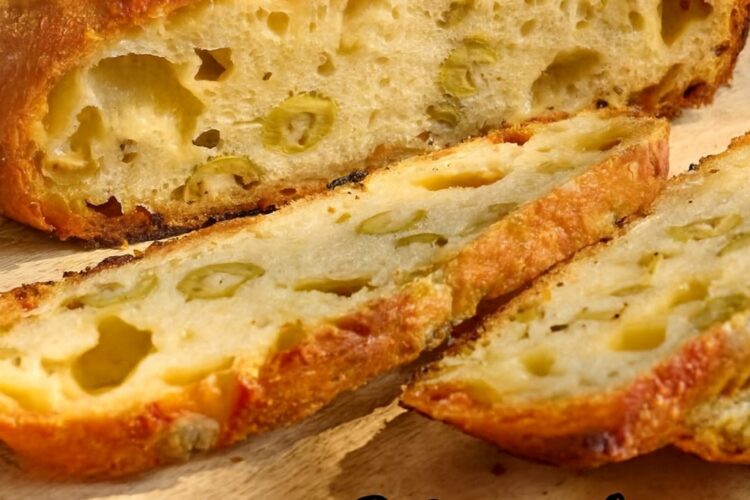
Dutch oven: A heavy Dutch oven holds heat incredibly well, making it the go-to vessel for no-knead loaves like this. With the lid on, it traps steam released from the dough in the initial baking phase, mimicking professional steam ovens. Removing the lid midway through makes for a crisp, browned crust with a chewy, moist interior.
Customizing This Recipe to Make It Your Own
There are so many ways to customize this loaf to suit your preferences:
- Swap in black or Kalamata olives for the green.
- Forgo the olives together in favor of raisins, walnuts, or jarred jalapeños.
- Instead of Gruyère, try asiago, Parmesan, or cheddar cheese.
- Add fresh or dried herbs like rosemary or thyme
- Omit all of the mix-ins to make a neutral-flavored, crusty loaf that pairs with just about anything.
Ingredients
- 3 cups bread flour, plus more for work surface
- 1 teaspoon fine sea salt
- ¾ teaspoon instant yeast or active-dry yeast
- 1 ¾ cups ½-inch cubes aged Gruyère cheese
- 1 ½ cups pitted ¼-inch-thick slices green Spanish olives
- 1 ½ cups cool water (55 to 65 degrees Fahrenheit), plus more as needed
Directions
Ingredients
- 3 cups bread flour, plus more for work surface
- 1 teaspoon fine sea salt
- ¾ teaspoon instant yeast or active-dry yeast
- 1 ¾ cups ½-inch cubes aged Gruyère cheese
- 1 ½ cups pitted ¼-inch-thick slices green Spanish olives
- 1 ½ cups cool water (55 to 65 degrees Fahrenheit), plus more as needed
Ingredients
:max_bytes(150000):strip_icc():format(webp)/MS-870547-olive-and-cheese-loaf-ingredients-4308-fb8db2fc692b44dea86217ff3394e045.jpg)
- Combine flour, salt and yeast; add other ingredients:In a medium bowl, stir together flour, salt, and yeast; stir in cheese and olives.
:max_bytes(150000):strip_icc():format(webp)/MS-870547-olive-and-cheese-loaf-1-4309-d97087031f134774a3bad3987297c89e.jpg)
- Add water and mix to form dough:Add water and, using a wooden spoon or your hand, mix until a wet, sticky dough forms, about 30 seconds, adding additional water, 1 tablespoon at a time, if needed.
:max_bytes(150000):strip_icc():format(webp)/MS-870547-olive-and-cheese-loaf-2-4312-6986579a9eef4d09a1f00aafbac8bad3.jpg)
- Cover and set aside to rise:Cover bowl with plastic wrap and let stand at room temperature until dough has doubled in size and surface becomes dotted with bubbles, 12 to 18 hours.
:max_bytes(150000):strip_icc():format(webp)/MS-870547-olive-and-cheese-loaf-3-4313-8f21cdd474e94153965271e2a34c1a7a.jpg)
- Form dough into round:Generously flour work surface; scrape dough onto work surface. Lightly flour hands, a bowl scraper, or a spatula and lift edges of dough toward the center. Nudge and tuck edges of dough to make round.
:max_bytes(150000):strip_icc():format(webp)/MS-870547-olive-and-cheese-loaf-4-4316-e077a20586884bd19b61b4098fe3ee1a.jpg) Credit: Jake Sternquist
Credit: Jake Sternquist - Wrap dough in parchment and leave to rise again:Place a piece of parchment paper on work surface and generously dust with flour. Gently place dough on parchment, seam-side down. If dough is tacky, lightly dust top with flour. Cover dough loosely with wax paper and two clean kitchen towels. Let dough stand in a warm, draft-free spot until almost doubled in size, 1 to 2 hours.
:max_bytes(150000):strip_icc():format(webp)/MS-870547-olive-and-cheese-loaf-5-4357-124b4d5369394e1c870513c8a441d1e8.jpg)
- Check dough:Gently poke dough with your finger; dough should hold the impression. If it springs back, let rise 15 minutes more.
- Preheat oven and prep Dutch oven:Ten minutes before dough has finished rising, preheat oven to 475°F on a conventional oven (450°F on a convection oven) with a rack in the lower third. Place a covered 3 1/2-quart cast-iron or enameled cast-iron Dutch oven (with plastic handle removed and screw hole plugged with aluminum foil) in center of rack.
- Place bread in Dutch oven and bake:Using pot holders, carefully remove preheated Dutch oven from oven and uncover. Uncover bread and loosen bottom with a large spatula. With the aid of the parchment paper, invert bread into preheated Dutch oven so that it is seam-side up. Cover Dutch oven and transfer to oven; bake for 25 minutes.
:max_bytes(150000):strip_icc():format(webp)/MS-870547-olive-and-cheese-loaf-6-4359-66b082970dba4bf19bff764df316ade3.jpg)
- Uncover and bake:Uncover and continue baking until bread is dark brown but not burnt, 15 to 30 minutes more.
:max_bytes(150000):strip_icc():format(webp)/MS-870547-olive-and-cheese-loaf-7-4481-a4ccac01301e46ef807aa24c58a8bbe1.jpg)
- Remove bread from Dutch oven and cool:Using a heatproof spatula or pot holders, gently lift bread from Dutch oven and transfer to a wire rack to cool.
:max_bytes(150000):strip_icc():format(webp)/MS-870547-olive-and-cheese-loaf-8-4484-339ff3a1824945bfb37d03fa0bace0a7.jpg)
How to Store Your No-Knead Loaf
This olive-studded loaf with keep at room temperature for 2 to 3 days stored in a breadbox or resealable bag (using the latter will result in a softer crust but you can remedy it with a quick toast). Always let bread cool completely before storing, and wait to slice it until you need it. You can also store this bread, sliced or not, in freezer for up to 3 months.