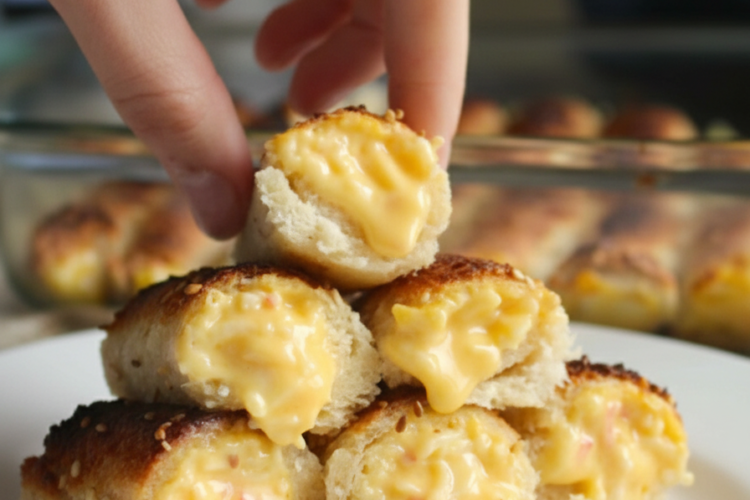
Nana’s Crab Roll-Ups: A Timeless Retro Appetizer
Introduction
Nana’s Crab Roll-Ups are a beloved retro appetizer that transports us back to the golden era of cocktail parties and family gatherings in mid-20th-century America. This simple yet irresistible dish combines creamy melted Velveeta cheese, buttery richness, flaky imitation crab meat, and soft white bread, all topped with nutty sesame seeds for a delightful crunch. Broiled to golden perfection, these bite-sized rolls offer a perfect balance of savory, cheesy indulgence with a hint of seafood flavor. Often passed down through generations, recipes like this one evoke memories of holiday potlucks, neighborhood parties, and special occasions where finger foods reigned supreme.
What makes Nana’s Crab Roll-Ups so enduringly popular is their deceptive simplicity. At first glance, the ingredients—processed cheese, imitation crab, and inexpensive white bread—might seem unassuming or even quirky. Yet, when combined and prepared with care, they create an addictive treat that disappears quickly from any appetizer tray. The surprise factor is part of the charm: guests often marvel at the “dough” only to learn it’s flattened bread, leading to delighted reactions and requests for the recipe. This dish exemplifies the ingenuity of home cooks from the 1950s and 1960s, who transformed everyday pantry staples into crowd-pleasing delights amid postwar prosperity and the rise of suburban entertaining.
In today’s fast-paced world, Nana’s Crab Roll-Ups remain relevant as a make-ahead appetizer that’s easy to prepare, budget-friendly, and universally appealing. They bridge generations, appealing to those nostalgic for vintage flavors while introducing younger palates to the joys of retro comfort food. Whether served at a holiday buffet, game day spread, or casual get-together, these roll-ups deliver warmth, texture, and taste in every bite. This comprehensive guide will explore their origins, cultural context, precise ingredients, variations, expert tips, step-by-step instructions, sensory description, nutrition, and more—inviting you to embrace this healthful indulgence in your own kitchen.
Origin
The exact origin of Nana’s Crab Roll-Ups is shrouded in the affectionate haze of family lore, much like many cherished homemade recipes from the mid-20th century. Variations of this dish appear in community cookbooks and online shares, often attributed to a “Nana” or grandmother who perfected it for family holidays. One popular version traces back to shared recipes on sites like 12 Tomatoes, where it’s described as a vintage gem that surprises guests with its bread-based “pastry.” These roll-ups likely emerged in American home kitchens during the 1950s or 1960s, a time when convenience foods and creative finger foods exploded in popularity.
This era saw the widespread adoption of processed ingredients like Velveeta cheese (introduced in 1928 but booming postwar) and imitation crab meat (surimi-based products gaining traction in the U.S. by the late 20th century, though earlier seafood substitutes existed). White bread, the “cheap stuff” specified in the recipe, was a staple in suburban pantries, reflecting the affordability and accessibility that defined postwar American cooking. The technique of flattening bread slices with a rolling pin and filling them echoes other retro roll-ups, such as asparagus or ham versions popular at bridge clubs and Tupperware parties.
While not directly tied to crab rangoon—an American-Chinese invention from the 1950s at Trader Vic’s tiki restaurants featuring cream cheese and crab in wonton wrappers—these roll-ups share a similar fusion spirit. Crab rangoon itself was a playful adaptation, blending Polynesian-inspired tiki culture with American tastes for creamy, fried appetizers. Nana’s version swaps deep-frying for broiling and uses bread instead of wrappers, making it simpler and more home-friendly. It fits squarely into the broader trend of “mock” seafood dishes, where imitation crab allowed landlocked families to enjoy “luxurious” flavors without the cost of real crab.
Ultimately, Nana’s Crab Roll-Ups represent grassroots American culinary creativity: grandmothers experimenting with new grocery items to feed crowds elegantly yet economically. Passed down orally or via handwritten cards, such recipes embody the warmth of family traditions, evolving slightly with each cook but retaining their core nostalgic appeal.
Cultural Significance
Nana’s Crab Roll-Ups hold a special place in the tapestry of American retro party culture, particularly from the 1950s and 1960s—a time when home entertaining reached new heights. Post-World War II prosperity brought refrigerators, freezers, and convenience products into millions of homes, fueling the cocktail party craze. Suburban housewives hosted elegant yet casual gatherings, serving an array of finger foods that allowed guests to mingle without formal sit-down meals. These roll-ups perfectly embody that ethos: easy to eat one-handed, preparable in advance, and visually appealing on a platter.
In the cultural landscape of the era, appetizers like these symbolized hospitality and ingenuity. Magazines like Better Homes and Gardens and cookbooks from Betty Crocker featured similar bite-sized treats—deviled eggs, cheese balls, pigs in a blanket, and stuffed celery—emphasizing make-ahead convenience for busy hostesses. Processed cheeses like Velveeta were celebrated for their meltability and shelf life, while imitation crab (or earlier canned versions) democratized seafood flavors, making “fancy” dishes accessible beyond coastal areas.
These roll-ups also reflect the playful fusion of influences in mid-century American cuisine. The sesame seed topping nods to emerging interest in Asian flavors (post-WWII exposure via soldiers and immigration), while the cheesy crab filling echoes tiki and Polynesian trends popularized by restaurants like Trader Vic’s. Yet, at heart, it’s pure Americana: transforming humble white bread into something gourmet-like, much like how Jell-O salads or fondue became party staples.
Today, Nana’s Crab Roll-Ups evoke nostalgia for simpler times, often resurfacing at potlucks, holidays, or retro-themed events. They remind us of intergenerational bonding—grandmothers teaching grandchildren in the kitchen—and the joy of shared meals. In a health-conscious era, they represent “guilty pleasure” indulgence, yet their portion-controlled size allows for mindful enjoyment. Reviving such recipes preserves cultural heritage, celebrating the resourcefulness of past generations while adapting to modern tastes.
Ingredients Quantity
To prepare Nana’s Crab Roll-Ups exactly as in the classic recipe, yielding approximately 40-50 pieces (depending on bread loaf size and cutting), you’ll need the following precise quantities. This serves 10-15 as an appetizer.
- ½ pound (8 ounces) Velveeta cheese, sliced for easier melting
This processed cheese provides the signature creamy, melty texture that’s irreplaceable in authentic versions. - 1 cup butter (2 sticks), divided
Use ½ cup (1 stick) for the filling and the remaining ½ cup melted for dipping. Unsalted or salted works; adjust seasoning if needed. - 8 ounces imitation crab meat (surimi)
Flaked or stick style; break into small pieces for even distribution. - 1 large loaf sliced white bread (the cheap, soft variety, about 20-24 slices)
Wonder Bread-style; avoid artisanal or dense loaves as they don’t flatten well. - ¼ cup sesame seeds
For sprinkling on top; toasted or untoasted both work, adding nutty flavor and crunch.
These quantities are scalable: double for larger crowds, but prepare in batches to maintain quality. Shop for fresh imitation crab from the seafood counter for best texture.
Optional Additions
While the classic recipe shines in its simplicity, optional additions can customize Nana’s Crab Roll-Ups to suit tastes or elevate the flavor profile without overpowering the retro charm.
Common enhancements include a dash of garlic powder or onion powder (½ teaspoon each) stirred into the cheese mixture for subtle savoriness. Finely chopped green onions or chives (2-3 tablespoons) add freshness and color. For a mild kick, incorporate ¼ teaspoon Worcestershire sauce or Old Bay seasoning—evoking East Coast seafood traditions.
Some variations suggest a pinch of cayenne or hot sauce for heat, or fresh herbs like dill or parsley for brightness. If upgrading the seafood, substitute half or all imitation crab with real lump crab meat for luxurious texture, though it increases cost.
For the bread, experiment with whole wheat for a nuttier base (though it may not roll as smoothly), or add everything bagel seasoning instead of plain sesame seeds. A light brush of garlic butter before broiling amps up aroma.
These additions keep the dish versatile: keep it pure for nostalgia or tweak for modern palates.
Tips for Success
Achieving perfect Nana’s Crab Roll-Ups requires attention to a few key techniques—here are expert tips gathered from countless home cooks.
First, use the softest, cheapest white bread possible; premium loaves resist flattening and may tear. Remove crusts cleanly for uniform rolls. When rolling out slices, apply even pressure with a rolling pin to achieve paper-thin flatness without holes—this ensures tight rolls and even cooking.
Melt the Velveeta and initial butter slowly over low heat or in the microwave, stirring frequently to prevent separation. Once combined with crab, the mixture should be spreadable but not runny; chill briefly if too soft.
Spread the filling in a thin line along one edge rather than all over—this prevents oozing and makes rolling easier. Roll tightly like a jelly roll for compact pieces.
Refrigeration is crucial: at least 1 hour (overnight is ideal) firms the rolls for clean cutting. Use a serrated knife with a sawing motion when halving.
For broiling, watch closely—ovens vary, and 3-5 minutes can turn golden to burnt quickly. Position rack 4-6 inches from heat, and rotate dish if needed for even browning.
Make ahead: assemble and refrigerate up to 24 hours, or freeze unbaked rolls (dip in butter and seeds just before broiling). Serve warm for peak melty goodness, but they’re tasty at room temperature too.
Avoid overfilling or loose rolls to prevent unraveling. If sesame seeds don’t stick, press gently.
With these tips, your roll-ups will be golden, crispy, and irresistible every time.
Instructions
Follow these detailed step-by-step instructions for flawless Nana’s Crab Roll-Ups.
- Prepare the filling: In a medium microwave-safe bowl or saucepan, combine the sliced ½ pound Velveeta cheese and ½ cup (1 stick) butter. Melt slowly in the microwave (30-second intervals, stirring) or over low heat on the stove, stirring until fully smooth and combined. Do not boil.
- Incorporate the crab: Break the 8 ounces imitation crab meat into small flakes or pieces. Add to the melted cheese-butter mixture and stir thoroughly until evenly distributed. Set aside to cool slightly.
- Prepare the bread: Remove crusts from all slices of the large loaf of white bread. Using a rolling pin, flatten each slice completely on a clean surface until very thin and pliable, about double the original size.
- Assemble the rolls: Place a flattened bread slice on your work surface. Spread a thin line (about 1-2 tablespoons) of the crab-cheese mixture along one short edge. Roll tightly from the filled edge, forming a log. Repeat with remaining slices, placing completed rolls seam-side down in a greased 9×13-inch baking dish.
- Chill: Cover the dish and refrigerate for at least 1 hour (up to overnight) to firm up.
- Final preparation: Preheat broiler to medium-high. Melt the remaining ½ cup butter. Remove rolls from fridge and cut each in half crosswise. Dip each half briefly in melted butter, then return to the baking dish seam-side down.
- Finish and broil: Sprinkle generously with ¼ cup sesame seeds. Broil 4-6 inches from heat for 3-5 minutes, watching carefully until tops are golden brown and bubbly.
- Serve: Remove from oven and let cool slightly. Serve warm for best texture and flavor.
Yield: 40-50 pieces. Prep time: 30 minutes active, plus chilling. Cook time: 5 minutes.
Description
Nana’s Crab Roll-Ups are a sensory delight from the first glimpse to the last bite. Visually, they present as elegant golden cylinders on a platter, their surfaces toasted to a warm amber hue with sesame seeds scattered like tiny jewels, adding textural contrast and subtle sheen from the butter dip.
The aroma is invitingly rich: buttery warmth mingles with the mild, creamy scent of melted cheese and a faint oceanic hint from the crab, accented by nutty toasted sesame as they emerge from the broiler.
Texture is where they truly shine—a crisp, buttery exterior gives way to a soft, pillowy bread layer enveloping the gooey, molten cheese-crab filling. The imitation crab provides delicate flakes that melt into the creaminess, while sesame seeds offer occasional crunchy pops.
Flavor-wise, it’s pure comfort: the Velveeta delivers smooth, tangy richness balanced by butter’s decadence, with imitation crab lending subtle sweetness and seafood essence without overpowering. Sesame adds earthy nuttiness, creating a harmonious savory profile that’s addictive yet not heavy.
Warm, they’re at their peak—oozing slightly when bitten, evoking fond memories of party trays past. Cooled, they firm up for easy handling, retaining charm as picnic or lunchbox treats.
Overall, these roll-ups are unpretentious elegance: simple ingredients transformed into something extraordinarily satisfying.
Nutritional Information
Nana’s Crab Roll-Ups are an indulgent treat, best enjoyed in moderation as part of a balanced diet. Nutritional values are approximate per piece (based on 50 pieces total yield), calculated from standard ingredient data.
Per serving (1 roll-up half):
- Calories: 120-140
- Total Fat: 9g (Saturated Fat: 5g)
- Cholesterol: 25mg
- Sodium: 300-350mg (high due to Velveeta and processed crab)
- Total Carbohydrates: 8g (Sugars: 1g)
- Protein: 3g
Key contributors: Butter and Velveeta drive fat and calories; white bread adds carbs; imitation crab provides low-fat protein (about 8g per 3oz serving overall, from fish like pollock).
Imitation crab is low in mercury and calories compared to real crab but higher in sodium and additives. Velveeta offers calcium but is processed. Sesame seeds contribute healthy fats and minerals.
For lighter versions: Use reduced-fat cheese/butter, real crab, or bake instead of broil. Overall, these are a flavorful occasional indulgence rich in comfort rather than nutrients.
Conclusion
Nana’s Crab Roll-Ups stand as a testament to the enduring magic of simple, heartfelt cooking. From their humble origins in mid-century kitchens to their place on modern tables, they capture the essence of shared joy—easy to make, delightful to eat, and evocative of cherished memories. This recipe’s beauty lies in its accessibility: no fancy tools or rare ingredients required, yet the result feels special.
In revisiting this classic, we honor the resourcefulness of past generations while creating new traditions. Whether recreating Nana’s exact version or adding personal twists, these roll-ups remind us that great food fosters connection.
Recommendation
I wholeheartedly recommend making Nana’s Crab Roll-Ups for your next gathering—they’re guaranteed crowd-pleasers that spark conversation and nostalgia. Perfect for holidays, potlucks, or casual evenings, they’ll vanish quickly. Start with the classic recipe for authenticity, then experiment once mastered.
Pair with crisp veggies, dips, or cocktails for a full retro spread. They’re forgiving for beginners yet rewarding for seasoned cooks.
Embracing Healthful Indulgence
While richly decadent, Nana’s Crab Roll-Ups can fit into a mindful lifestyle as occasional treats. Portion control allows enjoyment without guilt—savor one or two alongside fresh salads or fruits. Using quality ingredients and homemade touches elevates them.
Ultimately, food like this nourishes the soul: indulgence balanced with joy, tradition with creativity. Embrace these roll-ups as healthful in the broadest sense—feeding happiness, community, and well-being through delicious shared moments.