Introduction
Strawberry Rhubarb Custard Pie is a timeless dessert that captures the essence of spring and early summer in every creamy, tangy bite. This delightful pie combines the bold tartness of fresh rhubarb with the sweet juiciness of ripe strawberries, all enveloped in a silky smooth custard that sets to perfection within a flaky pie crust. Unlike traditional fruit pies that rely solely on thickened juices for structure, the custard variation adds an extra layer of richness and creaminess, transforming the classic strawberry rhubarb combination into something extraordinarily indulgent yet refreshingly balanced.
What makes this pie truly special is its ability to bridge seasons and generations, evoking memories of grandmother’s kitchen or bustling farm stands overflowing with fresh produce. The vibrant pink and red hues from the fruits create a visually stunning dessert, while the aroma of baking nutmeg and butter fills the home with warmth. Whether served chilled on a warm afternoon or slightly warmed with a scoop of vanilla ice cream, this pie offers a perfect harmony of flavors—tart, sweet, creamy, and spiced—that appeals to both adventurous palates and traditional tastes alike.
In this comprehensive guide, we’ll explore the fascinating origins of this beloved pie, delve into its cultural significance, break down the essential ingredients with precise quantities, suggest optional additions for customization, share expert tips for achieving baking success, provide detailed step-by-step instructions, offer a vivid description of the finished pie, examine its nutritional profile, and conclude with recommendations on how to fully embrace this healthful indulgence.
Origin
The story of Strawberry Rhubarb Custard Pie begins with the ancient history of rhubarb itself, a plant with roots tracing back thousands of years to Asia. Rhubarb, scientifically known as Rheum rhabarbarum, originated in regions like western China, Tibet, Mongolia, and Siberia, where it was primarily valued for its medicinal properties rather than its culinary potential. Ancient Chinese texts dating back to 2700 BC mention rhubarb for its laxative effects and ability to aid digestion, and it traveled along the Silk Road, becoming a prized commodity more expensive than many spices due to its perceived health benefits.
By the time rhubarb reached Europe in the 1600s and 1700s, it was cultivated in Britain and Germany mainly as a medicinal plant, but cooks soon discovered its edible stalks could mimic fruit in pies and tarts when sweetened heavily. The name “rhubarb” derives from the Latin “rhabarbarum,” meaning “root of the barbarians,” a somewhat derogatory term coined by the Romans who viewed its consumers as outsiders. Despite this, rhubarb gained popularity in England, where it was forced in dark sheds to produce tender, pink stalks—a technique still used today for premium varieties.
Rhubarb made its way to the American colonies in the early 18th century, with records showing seeds planted in Philadelphia in the 1730s, sent from England. However, it wasn’t until the 1800s that rhubarb became a staple in American kitchens, particularly in New England, the Midwest, and the Great Plains. Pioneers and settlers embraced it as “pie plant” because it was one of the earliest “fruits” available in spring, long before berries or tree fruits ripened, providing a vital source of fresh flavor after long winters of preserved foods.
The pairing of rhubarb with strawberries emerged as a natural evolution in the early 19th century, likely in rural American and British households where both grew abundantly in gardens. Strawberries, hybridized in Europe in the 1700s from American and European varieties, complemented rhubarb’s tartness perfectly with their natural sweetness. Early recipes for strawberry rhubarb pie appeared in American cookbooks by the mid-1800s, but the custard version added a creamy twist, drawing from European traditions of egg-based fillings like clafoutis or flan.
Custard pies have deep roots in English cuisine, with recipes dating back to medieval times, and immigrants brought these techniques to America. The specific strawberry rhubarb custard pie as we know it today likely developed in the early 20th century in Midwestern farm kitchens, where abundant rhubarb patches met fresh strawberries and dairy from local farms. Family recipes passed down through generations, like those from the 1950s featuring simple egg custards poured over fruits, solidified its place as a homey, comforting dessert.
Today, this pie remains a testament to resourceful cooking, turning a humble vegetable (yes, rhubarb is botanically a vegetable, though legally classified as a fruit in the U.S. since 1947 for tariff purposes) into a celebrated treat.
Cultural Significance
Strawberry Rhubarb Custard Pie holds a cherished place in culinary culture, particularly in regions where rhubarb thrives as a perennial garden staple. In the United States, it’s an iconic symbol of spring in New England and the Midwest, often heralding the end of winter with its emergence as one of the first harvestable crops. Farmers’ markets and roadside stands burst with rhubarb stalks in April and May, and pies made from them become centerpieces at community gatherings, church suppers, and family reunions.
This pie embodies themes of renewal and rebirth, as rhubarb pushes through the soil early in the season, offering a burst of color and flavor when little else is available. In New England cuisine, rhubarb pies are traditional desserts, reflecting the region’s history of resourceful Yankee cooking. The addition of strawberries ties it to summer’s bounty, making it a bridge between seasons. National Strawberry Rhubarb Pie Day on June 9th celebrates this combination, highlighting its enduring popularity.
Culturally, the pie evokes nostalgia, often associated with grandmothers and home baking. In the Great Plains and Midwest, where fruit trees were scarce for early settlers, rhubarb was dubbed “pie plant” and became essential for desserts. Recipes from the 1870s in newspapers like the Nebraska Advertiser feature “Pie Plant Pies,” underscoring its role in pioneer life. The custard variation adds a layer of comfort, reminiscent of old-fashioned cream pies that provided richness in dairy-rich farming communities.
In Britain, rhubarb remains popular in custards and fools, influencing American versions. The pie also represents communal evolution—no single inventor, but a collective innovation from home cooks experimenting with available ingredients. Today, it appears at festivals, in cookbooks, and on menus as a classic American dessert, often paired with ice cream for ultimate indulgence.
Its cultural resonance lies in balancing tart and sweet, mirroring life’s contrasts, and its simplicity celebrates seasonal, local eating.
Ingredients Quantity
To create a perfect 9-inch Strawberry Rhubarb Custard Pie that serves 8 generously, gather these precise ingredients. This recipe yields a balanced filling with prominent tart rhubarb notes softened by strawberries and enriched by custard.
- Unbaked pie crust: 1 (9-inch), preferably homemade for flakiness, but store-bought works well. It should fit a standard deep-dish pie plate to hold the generous filling without overflow.
- Rhubarb, chopped: 3 cups (about 1 pound of stalks), fresh and trimmed. Choose firm, crisp stalks with vibrant color—redder ones for prettier pink hues, though greener are equally tart and flavorful.
- Strawberries, quartered: 1 cup (about 8-10 ounces), ripe and juicy. Fresh in-season berries provide the best sweetness; hull and quarter them for even distribution.
- Eggs: 3 large, at room temperature for better incorporation into the custard.
- Granulated sugar: 1½ cups, to balance the intense tartness of the rhubarb while allowing natural flavors to shine.
- All-purpose flour: 3 tablespoons, which helps thicken and set the custard without making it stodgy.
- Milk: 3 tablespoons, adding subtle richness and creaminess to the custard base.
- Nutmeg: ¼ teaspoon, freshly grated if possible, for a warm, aromatic spice note that complements the fruits beautifully.
- Butter, diced: 1 tablespoon, cold and dotted on top for golden browning and extra buttery flavor.
These quantities ensure a pie that’s not overly sweet, with the custard setting firmly around the fruits.
Optional Additions
While the core recipe is perfection in simplicity, optional additions allow for personalization and enhancement. For the optional glaze: 2 tablespoons strawberry jam mixed with ¼ teaspoon water, heated gently for a glossy, professional finish that adds shine and a hint of extra strawberry intensity.
Consider adding ½ teaspoon vanilla extract or almond extract to the custard mixture for deeper flavor dimensions—vanilla enhances creaminess, while almond pairs elegantly with fruits. A pinch of salt (⅛ teaspoon) in the custard can heighten all flavors.
For texture variation, sprinkle a streusel topping before baking: mix ¼ cup flour, ¼ cup brown sugar, and 2 tablespoons butter into crumbs. Or, incorporate ¼ cup chopped nuts like pecans into the fruit layer for crunch.
If you prefer a double-crust pie, prepare a second crust for a lattice top, weaving strips over the custard for a classic look—though this alters the open-faced custard style. For a boozy twist, add 1 tablespoon orange liqueur to the custard.
Those seeking less sugar can reduce to 1 cup, relying more on ripe strawberries. Vegan adaptations might use plant-based milk, egg substitutes, and butter alternatives, though custard texture may vary.
These options keep the pie versatile for dietary needs or taste preferences.
Tips for Success
Achieving a flawless Strawberry Rhubarb Custard Pie requires attention to detail, especially with the delicate custard and juicy fruits. Start with fresh, high-quality produce: select crisp rhubarb stalks that snap when bent, avoiding limp or fibrous ones, and choose fragrant, ripe strawberries for maximum sweetness.
To prevent a soggy bottom crust, blind-bake the crust briefly at 375°F for 10 minutes with weights, or place the assembled pie on a preheated baking sheet to crisp the base. Gently tap the dish after pouring custard to release air bubbles, ensuring even setting.
Bake at a moderate 350°F to allow slow custard coagulation without curdling—rotate halfway for even browning, and test doneness by inserting a knife in the center; it should come out clean when set, typically 55-65 minutes. If edges brown too quickly, shield with foil.
Cool completely at room temperature before refrigerating to avoid condensation and sogginess; the pie improves overnight as flavors meld and custard firms. For cleaner slices, chill at least 1 hour, preferably overnight, and use a sharp knife dipped in hot water.
If using frozen rhubarb or strawberries, thaw and drain excess liquid to prevent watery filling. Fresh nutmeg makes a difference—grate it yourself for potent aroma.
Finally, trust the process: the filling may seem loose before baking, but it sets beautifully.
Instructions
Follow these detailed steps for a stunning Strawberry Rhubarb Custard Pie.
Preheat & Prep: Begin by preheating your oven to 350°F (175°C). Roll out or unfold your unbaked 9-inch pie crust and gently fit it into a standard pie dish, crimping edges decoratively if desired. Place the crust-lined dish on a large baking sheet to catch drips and make transfer easier.
Add the Fruit: Wash and trim the rhubarb stalks, discarding leaves (toxic) and ends, then chop into ½-inch pieces to yield 3 cups. Hull and quarter the strawberries for 1 cup. Evenly distribute the chopped rhubarb and quartered strawberries across the bottom of the prepared crust, creating a vibrant, layered base that will release juices during baking.
Prepare the Custard: In a medium mixing bowl, crack 3 large eggs and whisk vigorously. Add 1½ cups granulated sugar, 3 tablespoons all-purpose flour, 3 tablespoons milk, and ¼ teaspoon nutmeg. Whisk until completely smooth and blended—no lumps for silky custard. Slowly pour this mixture over the fruits in the crust, ensuring even coverage.
Bake: Dice 1 tablespoon cold butter into small pieces and dot evenly over the top for rich browning. Gently tap the pie dish on the counter to release trapped air bubbles. Slide into the preheated oven and bake for 55-65 minutes, rotating the baking sheet halfway through for uniform cooking. The pie is done when the custard is set (no jiggle in center) and top is golden.
Optional Glaze: While the pie bakes or cools, prepare the glaze if using: combine 2 tablespoons strawberry jam with ¼ teaspoon water in a small bowl and microwave briefly until smooth. Brush lightly over the warm or cooled pie for glossy appeal.
Cool & Serve: Remove from oven and cool completely on a wire rack (2-3 hours). Refrigerate for at least 1 hour before slicing to firm the custard. Serve chilled or at room temperature, perhaps with whipped cream or ice cream.
This method yields consistent, professional results every time.
Description
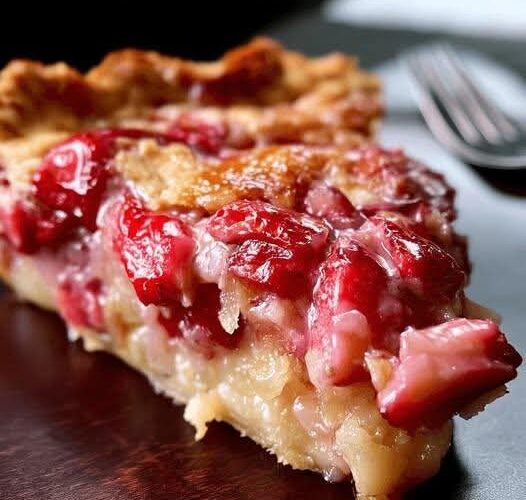
Imagine slicing into a Strawberry Rhubarb Custard Pie: the knife glides through a golden, flaky crust revealing a creamy custard layer hugging vibrant chunks of pink rhubarb and ruby strawberries. The top boasts subtle buttery spots and perhaps a glossy jam sheen, with nutmeg flecks adding warmth.
Visually, it’s a masterpiece of spring colors—deep reds and pinks contrasting pale custard. The aroma is intoxicating: tart rhubarb mingling with sweet strawberries, underscored by nutmeg and butter.
Texture-wise, the crust shatters crisply, giving way to velvety custard that coats the tongue, punctuated by tender rhubarb bites (tart yet mellowed) and juicy strawberry bursts. Flavors dance: initial tart rhubarb punch softened by strawberry sweetness, enriched by eggy custard and spice hints.
Chilled, it’s refreshing; slightly warm, comforting. Each bite balances indulgence and brightness, making it addictive yet light.
Nutritional Information
Strawberry Rhubarb Custard Pie offers delightful flavors with some nutritional benefits from fruits, though it’s a dessert best enjoyed in moderation. A typical 1/8 slice (about 120-150g) contains approximately 350-450 calories, depending on exact ingredients and crust type.
Breakdown per slice: Carbohydrates 50-60g (mostly from sugar and crust, with fiber from fruits); Fat 15-25g (from butter, eggs, crust); Protein 4-6g (from eggs and milk); Sugars 35-45g (natural from fruits plus added).
Positively, rhubarb provides vitamin K, calcium, potassium, and antioxidants like anthocyanins for heart health and anti-inflammatory effects. Strawberries add vitamin C, manganese, folate, and more antioxidants supporting immunity and skin health. The pie delivers about 2-4g fiber per slice, aiding digestion.
However, high sugar and calories make it indulgent—pair with protein for balance. Compared to plain fruit pies, custard adds richness from eggs (choline for brain health) and milk (calcium).
Overall, it’s a treat with wholesome elements from seasonal produce.
Conclusion
Strawberry Rhubarb Custard Pie stands as an enduring classic, blending history, seasonality, and pure deliciousness into one unforgettable dessert. From ancient Asian roots to American pioneer tables, it has evolved into a symbol of spring’s promise and summer’s arrival, offering comfort in every slice.
This pie’s magic lies in its perfect balance: tart rhubarb tamed by sweet strawberries and creamy custard, all cradled in buttery crust. It’s forgiving for beginners yet rewarding for experts, customizable yet perfect as is.
Baking this pie connects us to traditions of resourceful, joyful cooking, reminding us that simple ingredients can create extraordinary moments. Whether shared at gatherings or savored quietly, it leaves lasting impressions of warmth and satisfaction.
In a world of fleeting trends, this pie endures as a testament to timeless flavors.
Recommendation
I wholeheartedly recommend making Strawberry Rhubarb Custard Pie your next baking project, especially when fresh rhubarb and strawberries are in season. It’s ideal for spring brunches, summer picnics, Mother’s Day, or any occasion needing a showstopping dessert.
Pair slices with vanilla bean ice cream for contrast or lightly sweetened whipped cream for elegance. Serve chilled on hot days or room temperature for cozy evenings.
For gifting, bake in disposable tins; it travels well once set. Try variations like adding orange zest for citrus brightness or streusel for crunch.
Ultimately, this pie deserves a spot in your repertoire—bake it once, and it’ll become a requested favorite.
Embracing Healthful Indulgence
While Strawberry Rhubarb Custard Pie is undeniably indulgent, it embodies healthful indulgence when approached mindfully. The starring ingredients—rhubarb and strawberries—are nutritional powerhouses: rhubarb low in calories yet rich in fiber, vitamin K for bone health, and antioxidants potentially aiding digestion and reducing inflammation; strawberries bursting with vitamin C for immune support, folate for cell function, and polyphenols linked to heart protection.
By using fresh, seasonal produce, this pie incorporates real fruit benefits often absent in processed desserts. The custard provides protein and calcium from eggs and milk, adding satiety.
To enhance healthfulness, opt for whole-grain crusts, reduce sugar slightly if fruits are very ripe, or portion control with smaller slices alongside protein-rich meals. Enjoying it occasionally as part of a balanced diet allows guilt-free pleasure, celebrating nature’s bounty.
This pie proves desserts can nourish body and soul, encouraging mindful eating where flavor and wellness coexist harmoniously. Embrace it as a joyful, healthful treat that honors tradition while supporting well-being.