Introduction
Mamie Eisenhower’s Fudge, also famously known as Million Dollar Fudge, stands as one of the most iconic American dessert recipes of the mid-20th century. This rich, creamy chocolate confection captures the essence of post-war indulgence, when home cooks embraced convenience ingredients to create luxurious treats without the fuss of traditional candy-making. Named after Mamie Eisenhower, the elegant and gracious First Lady during Dwight D. Eisenhower’s presidency from 1953 to 1961, this fudge became a symbol of hospitality and holiday generosity. Its velvety texture, deep chocolate flavor, and optional nutty crunch have endeared it to generations, making it a staple in family recipe boxes across the United States. What makes this fudge truly special is its simplicity combined with an unparalleled richness that earned it the “million dollar” moniker—reportedly bestowed by President Eisenhower himself, who adored its decadent taste. In an era when First Ladies often shared recipes to connect with the public, Mamie’s fudge transcended the White House, becoming a nationwide favorite that evoked warmth, tradition, and unapologetic sweetness.
The recipe’s enduring appeal lies in its foolproof nature, relying on pantry staples and store-bought shortcuts like marshmallow creme and chocolate chips, which revolutionized fudge-making in the 1950s. No longer did cooks need to wrestle with candy thermometers or risk grainy results from traditional boiled fudge methods; this version delivered consistent creaminess every time. Today, as we revisit vintage recipes amid a resurgence of interest in retro comforts, Mamie Eisenhower’s Fudge reminds us of simpler times while offering a timeless indulgence. Whether prepared for holiday platters, gift-giving, or a personal treat, it embodies the spirit of sharing joy through food. This comprehensive guide will explore its origins, cultural impact, precise ingredients, variations, expert tips, step-by-step instructions, sensory description, nutrition, and why it deserves a place in your kitchen repertoire.
As we delve deeper, you’ll discover how this fudge not only sweetened the Eisenhower era but continues to bring people together around the table. Its story is intertwined with American history, reflecting the optimism and prosperity of the 1950s, when families gathered for festive occasions and homemade sweets were a hallmark of love and celebration.
Origin
The origins of Mamie Eisenhower’s Fudge trace back to the early to mid-20th century, with the recipe initially circulating under the name “Million Dollar Fudge” long before it became associated with the First Lady. Historical accounts suggest that similar no-fail fudge recipes using marshmallow creme emerged in the 1940s or earlier, capitalizing on the growing availability of convenience products like evaporated milk and jarred marshmallow fluff. However, the version we know today gained explosive popularity in 1953, during Dwight D. Eisenhower’s presidential election year, when it was featured in the Christmas edition of Women’s Home Companion, a widely read women’s magazine. Newspapers and publications across the country soon reprinted it, attributing it directly to Mamie Eisenhower, cementing its place in culinary lore.
A copy of the recipe even resides in the archives of the Eisenhower Presidential Library, underscoring its strong tie to the family despite debates over whether Mamie personally invented it or simply popularized an existing formula. Some sources note that President Eisenhower himself was the avid cook in the household, while Mamie was known for her hospitality rather than kitchen prowess—yet this fudge became her signature contribution. Legend has it that Ike loved it so much he dubbed it “million dollar” for its luxurious taste, a nickname that stuck and elevated its status. The recipe’s rise coincided with the post-World War II boom, when American homes were filled with new appliances and packaged goods, making elaborate-yet-easy desserts accessible to busy housewives.
By the late 1950s and throughout the 1960s, “Mamie’s Fudge” or “Mamie Eisenhower’s Million Dollar Fudge” appeared in countless community cookbooks, church fundraisers, and holiday spreads. Its no-cook chocolate addition after boiling the syrup marked a departure from finicky old-fashioned fudges that required precise temperature control to avoid seizing or crystallizing. This innovation—pouring hot syrup over chocolate and marshmallow creme—ensured a smooth, creamy result, democratizing fudge-making for the masses. The Eisenhowers’ White House years amplified its fame, as First Ladies of that era often shared “favorite” recipes to foster a relatable image, much like modern celebrity endorsements.
Interestingly, variations existed even then, with some prints calling for different chocolate ratios or boiling times, but the core remained consistent. The recipe’s pre-Eisenhower roots as generic “Million Dollar Fudge” highlight how public figures could transform everyday dishes into cultural icons. Today, preserved in presidential archives and family traditions, it serves as a delicious link to a pivotal chapter in American history.
Cultural Significance
Mamie Eisenhower’s Fudge holds profound cultural significance as a quintessential artifact of 1950s and 1960s American domestic life. In the prosperous post-war period, it represented the era’s embrace of convenience and abundance—using innovative products like marshmallow creme (popularized by brands like Kraft’s Jet-Puffed) and semisweet chocolate chips (introduced by Nestlé in the late 1930s). Traditional fudge demanded skill and patience, often resulting in failures that discouraged novice cooks; Mamie’s version, with its reliable method, empowered women to produce professional-quality candy at home, aligning with the idealized image of the efficient homemaker glorified in magazines like Ladies’ Home Journal and Good Housekeeping.
As a White House-associated recipe, it embodied patriotism and accessibility. During the Cold War years, when national unity was emphasized, sharing a presidential family’s “favorite” treat fostered a sense of connection between the elite and everyday Americans. Mamie, with her signature bangs and love of pink (even dubbing her inaugural gown “Mamie Pink”), projected warmth and style; her fudge extended that charm into kitchens nationwide. It became a holiday staple, perfect for gifting in tins to neighbors, teachers, or coworkers—a tradition that reinforced community bonds in suburban America.
The fudge’s unapologetic richness mirrored the decade’s indulgent spirit, contrasting with wartime rationing. Its popularity peaked alongside other convenience-driven classics like Jell-O salads and boxed cake mixes, which Mamie herself reportedly favored for White House entertaining to promote frugality despite grandeur. Culturally, it bridged generations: grandmothers passed clippings to daughters, who adapted it for potlucks and school bake sales. Even today, it evokes nostalgia for mid-century holidays, appearing in retro recipe revivals and presidential history exhibits.
Beyond sweets, it highlights the role of First Ladies in soft diplomacy through food. Similar to Eleanor Roosevelt’s economical dishes or Jacqueline Kennedy’s French-inspired elegance, Mamie’s fudge humanized the presidency. Its enduring presence in Southern and Midwestern cookbooks underscores regional baking traditions, while its “million dollar” name playfully nodded to aspirational luxury in an era of economic growth.
In modern culture, the recipe resurfaces during elections or historical anniversaries, reminding us of simpler pleasures amid complexity. It stands as a testament to how food preserves history, evoking smiles and stories around tables for over 70 years.
Ingredients Quantity
To make authentic Mamie Eisenhower’s Fudge, precision in measurements is key for achieving that signature creamy texture. The classic recipe yields a large batch—about 5 pounds—ideal for sharing or gifting. Here are the exact quantities based on the traditional version preserved in historical sources:
- 4 1/2 cups granulated sugar: This provides the base sweetness and structure, dissolving into the syrup for a smooth fondant-like quality.
- 1 pinch salt: Enhances flavor balance, cutting through the richness without overpowering.
- 2 tablespoons butter: Adds subtle creaminess to the boil and aids in smoothness; unsalted is preferred for control.
- 1 (12 oz or tall can, approximately 1 1/2 cups) evaporated milk: Not sweetened condensed— this canned milk contributes richness and prevents graininess during boiling.
- 2 cups (12 oz package) semisweet chocolate chips: These melt easily, providing deep chocolate intensity.
- 1 (12 oz package, typically 3 bars of 4 oz each) German sweet chocolate (Baker’s brand recommended): Broken into pieces; this milder, sweeter baking chocolate balances the semisweet chips for nuanced flavor—do not substitute with German-origin chocolate, as it’s named after inventor Samuel German.
- 1 pint (about 2 cups or two 7-8 oz jars) marshmallow creme: The secret to no-fail creaminess, acting as a stabilizer.
- 2 cups chopped nuts (optional, traditionally walnuts or pecans): Coarsely chopped for texture; omit for nut-free.
These quantities make approximately 117 one-inch squares in a 9×13-inch pan, or up to 24 larger servings. Scaling down by half fits an 8×8 pan for smaller batches.
Optional Additions
While the classic recipe shines in its simplicity, optional additions allow personalization without straying far from tradition. The most common is the 2 cups chopped nuts—walnuts for earthy crunch or pecans for buttery Southern flair—folded in for textural contrast. For modern twists:
- Swirl in peanut butter (1/2 cup) for a Reese’s-like variation, balancing sweetness with saltiness.
- Add 1 teaspoon vanilla extract post-boil for aromatic depth.
- Incorporate dried fruits like cherries or cranberries (1 cup) for tart bursts, evoking holiday fruitcake notes.
- Top with sea salt flakes before setting for a trendy salted chocolate edge.
- Experiment with different chocolates: substitute part of the German sweet with milk chocolate for extra creaminess or dark for intensity.
- Mini marshmallows or toffee bits for added chew.
These keep the fudge’s essence intact while inviting creativity—perfect for adapting to dietary preferences or seasonal themes.
Tips for Success
Achieving perfect Mamie Eisenhower’s Fudge requires attention to technique, as the boiling stage is critical. Stir constantly during the boil to prevent scorching—use a heavy-bottomed saucepan for even heat distribution. Time the 6-minute boil precisely from the moment it reaches a full rolling boil (one that doesn’t stop when stirred); altitude affects this, so high-elevation cooks may need adjustments. Use a wooden spoon for vigorous stirring when melting chocolate to incorporate air for creaminess.
Prepare everything in advance: grease or line the pan with foil for easy removal, and have chocolate, creme, and nuts ready in a large bowl. Pour the hot syrup over them immediately off heat to melt smoothly. Avoid humid days, as moisture can cause seizing. Let cool undisturbed at room temperature (overnight preferred) before refrigerating—rushing this leads to soft fudge. For cleaner cuts, chill fully then use a hot knife.
Common pitfalls: overboiling yields brittle fudge; underboiling keeps it too soft. Test doneness by dropping a bit in cold water if unsure—it should form a soft ball. Store in airtight containers; it improves on day two as flavors meld.
Instructions
Follow these detailed steps for flawless results:
- Grease a 9×13-inch baking dish generously with butter or line with parchment/foil for easy lift-out. This prevents sticking and simplifies cutting.
- In a large, heavy saucepan over medium heat, combine 4 1/2 cups granulated sugar, pinch of salt, 2 tablespoons butter, and 12 oz evaporated milk. Stir constantly until the mixture comes to a full rolling boil—this takes about 5-10 minutes.
- Once boiling vigorously, continue cooking for exactly 6 minutes, stirring nonstop to avoid burning on the bottom. The mixture will bubble and thicken slightly.
- Remove from heat immediately. Quickly add 2 cups semisweet chocolate chips, 12 oz broken German sweet chocolate, and 1 pint marshmallow creme to the hot syrup (or pre-place in a bowl and pour syrup over).
- Stir vigorously until all chocolate melts and the mixture is glossy and smooth—about 5 minutes of arm workout.
- If using, gently fold in 2 cups chopped nuts until evenly distributed.
- Pour into the prepared dish, spreading evenly with a spatula. Tap to release air bubbles.
- Cool completely at room temperature (several hours or overnight), then refrigerate until firm (at least 4 hours).
- Lift out using foil overhang, cut into squares with a sharp knife, and enjoy.
Prep: 10 minutes. Cook: 10 minutes. Chill: 4+ hours.
Description
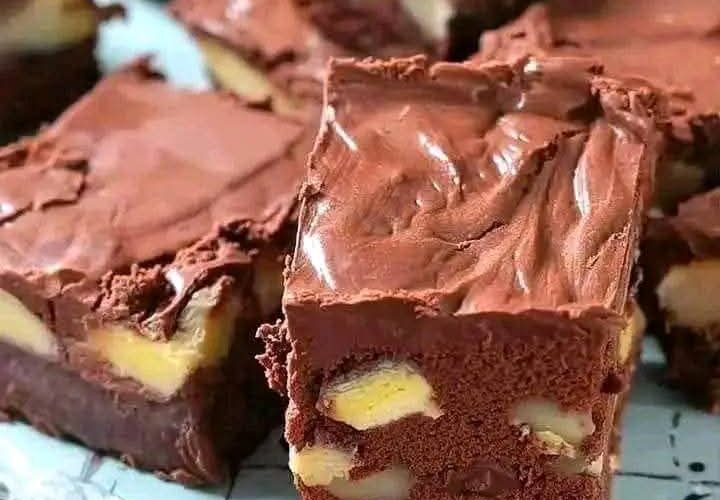
Mamie Eisenhower’s Fudge is a masterpiece of texture and taste: ultra-creamy with a dense, fudgy bite that melts luxuriously on the tongue. Its deep chocolate hue gleams invitingly, flecked with nut pieces if included, and cuts into perfect squares that hold their shape yet yield softly. The flavor profile layers semisweet intensity with the milder sweetness of German chocolate, tempered by marshmallow creme’s fluffy lightness—resulting in a balanced richness that’s decadent without overwhelming. Optional nuts add satisfying crunch, contrasting the velvety smoothness.
Visually, it’s elegant simplicity: glossy slabs on a platter evoke vintage holiday tins. Aromatically, it fills the kitchen with comforting cocoa warmth during preparation. Each bite delivers nostalgic comfort—sweet, indulgent, and utterly satisfying, like a hug from the past.
Nutritional Information
Per serving (1 square, assuming 117 pieces without nuts): approximately 150 kcal, primarily from carbohydrates (26g sugars) and fats (6g, mostly saturated from chocolate and butter). Protein around 2g; minimal fiber. With nuts, add healthy fats and slight protein boost, but calories rise to ~170-180 per piece.
This is an indulgent treat high in sugar and calories—enjoy in moderation. Full batch: thousands of calories, best shared!
Conclusion
Mamie Eisenhower’s Fudge endures as more than a recipe—it’s a slice of American heritage, blending history, convenience, and pure delight. From White House tables to modern kitchens, its creamy richness continues to captivate.
Recommendation
I wholeheartedly recommend making this fudge for holidays, gifts, or anytime cravings strike. It’s foolproof, crowd-pleasing, and evokes joy.
Embracing Healthful Indulgence
While richly indulgent, this fudge can fit a balanced life—savor small pieces mindfully, pair with fruit, or adapt with darker chocolate for antioxidants. Embrace it as occasional treat celebrating tradition and moderation.