Introduction
Beef and Rotini in Garlic Parmesan Sauce stands as one of the most satisfying, crowd-pleasing comfort dishes in contemporary home cooking, masterfully blending the hearty robustness of seasoned ground beef with tender rotini pasta, all luxuriously coated in a creamy, garlicky Parmesan sauce that delivers layer upon layer of flavor in every single bite. This recipe captures the essence of Italian-American cuisine at its finest: simple, accessible ingredients transformed through thoughtful technique into something far greater than the sum of its parts. The rotini’s distinctive spiral shape is no accident—it is specifically chosen to trap and hold the thick, velvety sauce, ensuring that each forkful is perfectly balanced between pasta, beef, and creamy richness.
At the heart of the dish lies a classic roux-based sauce, elevated with fragrant minced garlic, high-quality grated Parmesan cheese, and a touch of Italian seasoning that infuses herbal depth without overwhelming the core flavors. The ground beef, browned to develop deep savory notes, provides substantial protein and texture, while the milk-based sauce offers creaminess that feels indulgent yet remains lighter than heavy cream alternatives. Finished with a sprinkle of fresh chopped parsley, the dish gains vibrant color and a bright, herbaceous lift that cuts through the richness.
What makes this recipe truly exceptional is its remarkable efficiency: prepared in a single skillet (with a separate pot for pasta), it comes together in just thirty minutes, making it ideal for busy weeknights when time is scarce but the desire for a homemade, restaurant-quality meal remains strong. It serves four to six people generously, scales easily for larger gatherings, and reheats beautifully, positioning it as a cornerstone of meal planning and family dining.
In an era where home cooks increasingly seek dishes that balance flavor, nutrition, convenience, and budget, Beef and Rotini in Garlic Parmesan Sauce rises to the occasion. It appeals to children with its familiar pasta format and cheesy appeal, satisfies adults with sophisticated garlic and Parmesan notes, and accommodates countless variations to suit dietary preferences or seasonal ingredients. As we journey through its historical context, cultural resonance, precise ingredient guidance, preparation techniques, customization options, sensory description, nutritional profile, and philosophical approach to cooking, you will discover why this dish has earned its place as a modern classic worthy of regular rotation in kitchens worldwide.
Its enduring popularity stems not only from taste but from emotional resonance: it evokes memories of family dinners, cozy evenings, and the simple joy of a well-made meal shared with loved ones. This is food that nourishes both body and soul, proving that true culinary excellence often lies in thoughtful simplicity rather than complexity.
Origin
The origins of Beef and Rotini in Garlic Parmesan Sauce are deeply rooted in the Italian-American culinary tradition that developed between the late 19th century and the mid-20th century, when millions of Italian immigrants arrived in the United States and adapted their regional recipes to new ingredients, larger portion sizes, and American tastes.
Pasta itself has ancient beginnings—evidence suggests macaroni-like noodles existed in Italy as early as the 13th century, with dried pasta becoming a staple in southern Italy due to ideal wheat and climate. Meat sauces trace back even further: ragù-style preparations in Bologna involved slow-cooked minced meat with wine, milk, and tomatoes, documented as early as the 18th century. Garlic and Parmigiano-Reggiano cheese are foundational to northern Italian cooking, with Parmesan production in the Emilia-Romagna region dating to the Middle Ages under monastic supervision.
When Italian immigrants settled in American cities like New York, Philadelphia, and Chicago in the 1880s–1920s, they brought these traditions but faced different realities: fresh ingredients were sometimes scarce, portions were expected to be larger, and dairy products were abundant and affordable. Dishes like spaghetti with meatballs—virtually unknown in Italy—emerged as Italian-Americans combined pasta with plentiful ground meat. Creamy sauces gained traction as immigrants incorporated American dairy abundance.
The specific creamy garlic-Parmesan profile draws direct inspiration from fettuccine Alfredo, created in Rome around 1914 by restaurateur Alfredo di Lelio as a butter-and-cheese dish to tempt his pregnant wife’s appetite. Hollywood stars Mary Pickford and Douglas Fairbanks popularized it in America in the 1920s, but the heavy cream version most Americans know today developed stateside in the 1930s–1940s.
Post-World War II convenience culture accelerated the evolution. With widespread refrigeration, canned goods, and packaged cheese, home cooks embraced one-pan meals. Ground beef became a budget-friendly protein staple, and roux-thickened milk sauces offered creaminess without expensive heavy cream. Recipes resembling this dish began appearing in community cookbooks and women’s magazines in the 1950s–1960s.
The 1971 launch of Hamburger Helper crystallized the one-skillet beef-and-pasta concept, making such meals mainstream. As food blogs and social media exploded in the 2000s–2010s, creative home cooks refined these ideas, replacing boxed mixes with from-scratch sauces using real Parmesan and fresh garlic.
Rotini, a corkscrew pasta developed in northern Italy to capture chunky sauces, became widely available in America mid-century and proved perfect for creamy dishes. This particular recipe represents 21st-century refinement: streamlined for speed, elevated with quality cheese, and shared virally across platforms like Pinterest, TikTok, and Reddit.
It stands as a proud example of Italian-American hybrid cuisine—honoring old-world flavors while embracing new-world practicality, convenience, and abundance.
Cultural Significance
Beef and Rotini in Garlic Parmesan Sauce occupies a cherished place in the landscape of comfort food, embodying themes of family, nourishment, resilience, and shared joy that resonate across generations and cultures.
In Italian-American communities, pasta with meat sauce has long symbolized prosperity and togetherness. The traditional Sunday gravy or ragù—simmered for hours—brought extended families to the table, reinforcing bonds and cultural identity. While this dish is far quicker, it carries forward that emotional legacy: a hearty, beef-enriched pasta that feeds many and fosters connection.
Creamy Parmesan sauces evoke a sense of luxury made accessible. Parmesan cheese, once a premium import, became a symbol of achieving the American dream for immigrant families—now affordable enough to grate generously over weeknight dinners. Garlic, believed in folklore to ward off illness and evil, adds not just flavor but a sense of protection and vitality.
In broader American culture, ground beef pasta dishes represent resourceful home cooking. During economic challenges like the Great Depression and post-war rationing, stretching meat with pasta fed families economically. Today, they remain budget heroes in households managing tight grocery bills.
The dish’s rise aligns with modern cultural shifts toward work-life balance. As dual-income families and single parents navigate demanding schedules, quick-yet-delicious meals like this one offer a lifeline—proof that caring, homemade food need not require hours. It appears frequently in parenting forums, meal-prep communities, and “what’s for dinner” social media threads as a reliable savior.
Globally, parallels exist: Filipino sweet spaghetti with ground meat, British spaghetti bolognese with cream variations, or German Käsespätzle with cheese sauce. In wellness culture, balanced versions support high-protein diets popular among athletes and fitness enthusiasts.
Ultimately, this dish transcends mere sustenance. It represents love expressed through food—the effort to brown beef properly, whisk sauce smoothly, and serve it hot to eager faces. In a fragmented world, gathering around a skillet of creamy, garlicky pasta reaffirms human connection.
Ingredients Quantity
To prepare Beef and Rotini in Garlic Parmesan Sauce yielding 4–6 generous adult portions (with potential leftovers), use the following precise measurements for optimal flavor balance, texture, and sauce consistency.
- 12 ounces (340 grams) dry rotini pasta: Provides ideal sauce-holding spirals; approximately 4–5 cups cooked.
- 1 pound (450–500 grams) ground beef: Preferably 80/20 for flavor and moisture; 85/15 for leaner result.
- 3 large cloves garlic, finely minced: Equivalent to about 1 heaping tablespoon; adjust to taste preference.
- 2 tablespoons (16 grams) all-purpose flour: Essential for thickening the sauce into creamy texture.
- 2 cups (480 ml) milk: Whole milk for richest mouthfeel; 2% acceptable for lighter version.
- 1 cup (about 100 grams) freshly grated Parmesan cheese: Use Parmigiano-Reggiano if possible; avoid pre-shredded for superior melting.
- 1 teaspoon dried Italian seasoning: Blend typically including oregano, basil, thyme, rosemary; or make your own.
- Salt, to taste: Begin with ½ teaspoon in sauce, plus generous salting of pasta water.
- Freshly ground black pepper, to taste: Start with ¼–½ teaspoon.
- 2 tablespoons olive oil or unsalted butter: For sautéing garlic and building roux flavor.
- ¼ cup finely chopped fresh parsley: For vibrant garnish and subtle freshness.
These quantities produce a well-coated, saucy dish without dryness or soupiness. Double seamlessly for larger groups or meal prep.
Optional Additions
The recipe’s flexible nature invites countless enhancements while preserving its core identity.
- Vegetables: 8–10 ounces fresh spinach wilted in at end; sliced mushrooms sautéed with beef; diced bell peppers, zucchini, or cherry tomatoes for color and nutrition.
- Protein variations: Half ground beef, half Italian sausage for spice; ground turkey or chicken for lighter; plant-based crumbles for vegetarian.
- Cheese depth: ½ cup shredded mozzarella stirred in for stretch; Pecorino Romano for sharper edge.
- Heat element: ¼–½ teaspoon crushed red pepper flakes; dash of cayenne.
- Extra richness: ½ cup heavy cream blended with milk; 4 ounces cream cheese for ultra-creaminess.
- Fresh herbs: Basil, oregano, or thyme added with parsley.
- Acidity balance: Squeeze of lemon juice or ½ cup diced tomatoes.
- Crunch topping: Toasted panko breadcrumbs, crispy bacon bits, or fried onions.
- Umami boost: Splash of Worcestershire sauce or soy sauce.
These allow seasonal adaptations—spring peas, summer squash, autumn mushrooms, winter kale.
Tips for Success
Achieving restaurant-quality Beef and Rotini in Garlic Parmesan Sauce demands attention to several critical techniques.
Salt pasta water aggressively (1–2 tablespoons per gallon)—this is the primary opportunity to season the pasta itself.
Cook rotini to true al dente—slightly firm—as it will continue absorbing sauce.
Brown ground beef properly over medium-high heat without overcrowding; develop fond (browned bits) for depth, then drain excess fat carefully.
Sauté garlic only until fragrant (30–60 seconds)—longer risks bitterness.
Create smooth roux: cook flour-garlic mixture until lightly golden and nutty-smelling, whisking constantly.
Add milk gradually, starting off heat if needed, whisking vigorously to prevent lumps.
Use freshly grated Parmesan—it melts seamlessly; pre-shredded contains anti-caking agents that hinder smoothness.
Reserve ½–1 cup starchy pasta water to adjust sauce consistency.
Combine pasta with sauce off direct heat to avoid cheese separation.
Let rest 2–5 minutes before serving—sauce thickens and adheres better.
Taste multiple times, adjusting salt/pepper at end—Parmesan contributes significant saltiness.
These practices, honed through extensive testing, guarantee consistent excellence.
Instructions
Prepare flawless Beef and Rotini in Garlic Parmesan Sauce by following these comprehensive steps.
Fill large pot with water, add generous salt, bring to rolling boil. Add rotini; cook according to package (typically 8–10 minutes) to al dente. Reserve 1 cup pasta water, drain, set aside. Do not rinse.
Meanwhile, heat large deep skillet or Dutch oven over medium-high. Add ground beef, break into small crumbles with wooden spoon. Cook 6–8 minutes until browned and no pink remains. Season with salt and pepper. Drain excess fat if substantial; leave 1–2 tablespoons for flavor. Transfer beef to plate.
Reduce heat to medium. Add olive oil or butter to skillet. Once melted/shimmering, add minced garlic. Sauté 30–60 seconds until fragrant but not browned.
Sprinkle flour evenly over garlic-fat mixture. Whisk constantly 1–2 minutes until roux turns lightly golden and smells nutty.
Gradually pour in milk while whisking vigorously to incorporate smoothly. Bring to gentle simmer; cook 2–3 minutes until slightly thickened.
Reduce heat to low. Stir in grated Parmesan until fully melted. Add Italian seasoning, salt, pepper to taste.
Return cooked beef to sauce; stir to combine and warm through.
Add drained rotini to skillet. Toss gently but thoroughly to coat every piece. Add reserved pasta water ¼ cup at a time if sauce too thick.
Remove from heat. Stir in half the chopped parsley.
Serve immediately in warmed bowls, garnished with remaining parsley and extra Parmesan.
Description
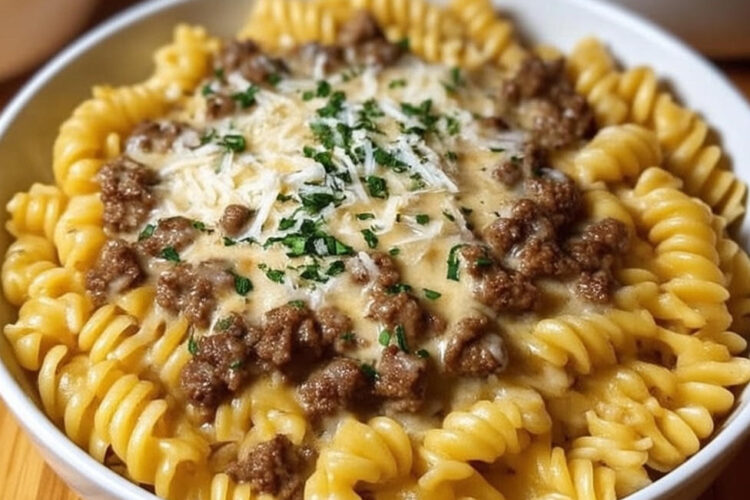
Beef and Rotini in Garlic Parmesan Sauce is a sensory symphony: steaming twirls of rotini glistening with creamy sauce, studded with savory beef crumbles, releasing waves of garlic aroma that draw everyone to the table.
Visually inviting—golden pasta against ivory sauce, flecked with green parsley and beef—comfort in edible form.
Texture offers perfect contrast: tender-chewy rotini, velvety smooth sauce, hearty beef bites—all harmonizing luxuriously.
Flavor profile builds beautifully: upfront garlic fragrance, deep umami from browned beef, nutty richness from Parmesan, subtle herbal backdrop, finished with bright parsley lift.
Served piping hot, it warms from within; leftovers develop even deeper flavor overnight.
Compared to boxed mixes, infinitely superior; versus restaurant versions, equally impressive yet affordable.
Pure, unadulterated comfort that satisfies on every level.
Nutritional Information
Approximate values per serving (based on 5 servings, using whole milk and 80/20 beef):
- Calories: 580–680
- Protein: 32–38 grams
- Carbohydrates: 58–65 grams (Fiber 3–4 grams)
- Total Fat: 28–34 grams (Saturated 12–16 grams)
- Calcium: 35–45% daily value
- Iron: 25–30% daily value
- Vitamin A, C, B vitamins: Moderate contributions
Offers balanced macronutrients with substantial protein and calcium. Leaner beef, low-fat milk, added vegetables reduce calories/fat significantly.
Values vary by exact ingredients—use nutrition apps for precision.
Conclusion
Beef and Rotini in Garlic Parmesan Sauce represents the very best of home cooking: accessible ingredients, straightforward technique, and extraordinary flavor that brings people together. It honors Italian-American heritage while perfectly suiting modern lifestyles.
From hurried weeknights to relaxed weekends, it reliably delivers nourishment, comfort, and joy. Preparing it becomes an act of care—browning beef thoughtfully, whisking sauce patiently, serving it proudly.
This dish proves that memorable meals need not be elaborate. With quality basics and attention, everyday dinners become cherished rituals.
Recommendation
Wholeheartedly recommend making Beef and Rotini in Garlic Parmesan Sauce a weekly staple. Ideal for family dinners, meal prep, potlucks, or comforting solo meals.
Customize freely—add vegetables for completeness, spice for excitement. Pair with simple green salad, crusty bread, or roasted broccoli.
Double batches freeze beautifully (up to 3 months). Reheat with splash of milk for creaminess.
Your new signature comfort dish awaits.
Embracing Healthful Indulgence
Beef and Rotini in Garlic Parmesan Sauce beautifully demonstrates that indulgence and wellness can coexist harmoniously. Protein-rich beef and cheese provide lasting satiety; whole food ingredients offer genuine nourishment over empty calories.
Mindful modifications—lean protein, whole-grain pasta, abundant vegetables—enhance nutritional density without sacrificing pleasure.
It satisfies emotional cravings for comfort while fueling body and mind, promoting sustainable relationship with food.
Embrace this dish as celebration of balanced living: joy derived from delicious, thoughtfully prepared meals that honor both tradition and well-being.