Introduction
Baked Herb & Cheese Scones represent a delightful twist on the classic British baked good, transforming the traditionally sweet afternoon tea staple into a savory masterpiece that’s perfect for any time of day. These tender, flaky scones are infused with sharp cheddar cheese and a medley of fresh herbs, creating layers of rich, tangy flavor with subtle aromatic notes that elevate them beyond ordinary bread. Unlike their sweeter counterparts often slathered with jam and clotted cream, these savory versions shine alongside hearty soups, as part of a brunch spread, or simply enjoyed warm with a pat of butter. The beauty of Baked Herb & Cheese Scones lies in their versatility—they can be a comforting snack on a chilly afternoon, a sophisticated side for dinner, or even the base for miniature sandwiches filled with eggs or ham. What makes them truly special is the contrast between the crisp, golden exterior and the soft, buttery interior dotted with melted cheese pockets and flecks of green herbs. This recipe yields eight wedges, each one a harmonious blend of simplicity and indulgence, proving that savory baking can be just as rewarding as sweet. As we dive deeper into their story, you’ll discover how these scones bridge tradition with modern tastes, offering a healthful yet decadent treat that’s easy to master at home.
The allure of these scones extends far beyond their taste; they embody a sense of warmth and homeliness that invites sharing. Imagine pulling a tray from the oven, the air filled with the scent of baking cheese and fragrant herbs—it’s an experience that turns an ordinary kitchen moment into something memorable. Whether you’re a seasoned baker or a novice, this recipe is forgiving and rewarding, encouraging experimentation while delivering consistent results. In the sections ahead, we’ll explore their fascinating origins, cultural role, precise ingredients, helpful tips, and more, all to help you create scones that are not only delicious but also a reflection of thoughtful, flavorful baking.
Origin
The story of scones begins in the rugged landscapes of Scotland, where they are believed to have originated in the early 1500s, making them one of the oldest quick breads in British culinary history. The first printed reference to scones appears in a 1513 Scottish poem by Gavin Douglas, hinting at their humble roots as a simple, griddle-baked flatbread made primarily from oats or barley. These early scones were shaped into large rounds, scored into wedges, and cooked on a girdle or bakestone over an open fire—a practical method for rural households without ovens. The name “scone” itself is shrouded in etymological mystery, possibly deriving from the Scottish Gaelic “sgonn” meaning a shapeless mass, or from Dutch “schoonbrot” signifying fine bread, or even linked to the Stone of Scone, the ancient coronation site for Scottish kings. Regardless of the exact linguistic path, these oat-based creations were a staple for the working classes, often paired with broth or eaten plain with cheese.
As trade routes expanded and ingredients like wheat flour, butter, and chemical leaveners became accessible in the 19th century, scones evolved dramatically. Baking powder replaced griddle cooking, allowing for oven-baked versions that rose taller and flakier. While sweet scones with currants gained fame through English afternoon tea, savory variations emerged naturally, incorporating local cheeses and garden herbs—a nod to the resourcefulness of home cooks. Cheddar, a sharp English cheese with roots in Somerset, became a popular addition, its bold tang complementing the neutral dough perfectly. Fresh herbs like chives, parsley, and thyme, abundant in British gardens, added freshness and aroma, turning scones into versatile savory treats. This shift mirrored broader culinary changes, where scones moved from peasant fare to refined offerings, yet retained their quick-bread essence—no yeast, minimal kneading, and rapid preparation.
By the Victorian era, scones had crossed class lines, but savory cheese and herb versions remained popular in everyday meals, especially in Scotland and northern England, where hearty flavors prevailed. Today, Baked Herb & Cheese Scones honor this evolution, blending Scottish origins with modern savory innovation, proving how a simple ancient recipe adapts across centuries while staying true to its flaky, comforting core.
Cultural Significance
Scones hold an iconic place in British culture, symbolizing comfort, tradition, and social ritual, though their sweet form dominates the spotlight in the famed afternoon tea. Originating in Scotland, scones are as intrinsically Scottish as porridge, yet they became synonymous with English elegance when Anna, the Duchess of Bedford, popularized afternoon tea in the 1840s to bridge the gap between lunch and late dinner. Served warm with clotted cream and jam, plain or fruit-studded scones became the centerpiece of this genteel pastime, sparking endless debates over pronunciation (“skon” vs. “skoon”) and topping order (cream first in Devon, jam first in Cornwall). This ritual spread across the British Empire, influencing tea cultures in Australia, New Zealand, Canada, and beyond, where scones evoke nostalgia and hospitality.
Savory scones like our Herb & Cheese variety, however, reveal a more everyday cultural role, rooted in practicality and regional flavors. In Scotland and Ireland, cheese scones are breakfast or snack staples, often enjoyed with butter or as part of a ploughman’s lunch. They reflect the resourceful use of dairy and herbs in rural diets, contrasting the sweeter English tea-time versions. Worldwide, scones have adapted: in America, they’re larger and sweeter, akin to biscuits; in New Zealand, cheese scones are a cafe favorite. Yet, the savory herb and cheese scone embodies a bridge between tradition and modernity—healthful indulgence without excess sugar, perfect for contemporary palates seeking balance.
Culturally, these scones foster connection: shared at brunches, picnics, or family gatherings, they encourage lingering conversations much like afternoon tea. In a fast-paced world, baking them revives slow, mindful rituals, celebrating heritage while embracing innovation.
Ingredients Quantity
To make eight delicious Baked Herb & Cheese Scones, gather these precise ingredients, measured accurately for best results. All-purpose flour forms the base at 2 cups (about 250 grams), providing structure without heaviness. Baking powder, 1 tablespoon, acts as the primary leavener, ensuring a good rise and tender crumb. Salt, ½ teaspoon, enhances flavors, while black pepper, ¼ teaspoon, adds a subtle kick that complements the cheese.
Cold unsalted butter, cubed into ¼ cup (about 57 grams), is crucial for flakiness—its pockets melt during baking, creating steam for layers. Shredded sharp cheddar cheese, 1 cup (about 113 grams), delivers tangy richness; opt for extra-sharp for bolder taste. Chopped fresh herbs, 2 tablespoons total, bring vibrant aroma—use a mix of chives for oniony notes, parsley for freshness, thyme for earthiness, or rosemary for piney depth. Milk, ¾ cup (about 180 ml), binds the dough gently; whole milk yields richer results, but low-fat works too. Finally, one beaten egg serves as an egg wash, promoting a glossy, golden top.
These quantities yield scones that are balanced—not too dry, not overly wet—perfectly portioned for sharing or meal prepping.
Optional Additions
While the core recipe shines in simplicity, optional additions allow customization, turning these scones into personalized delights. For extra savoriness, incorporate ½ cup cooked, crumbled bacon or diced ham, creating a heartier version ideal for breakfast sandwiches. Sun-dried tomatoes, about ¼ cup chopped, add tangy sweetness and chewy texture, pairing beautifully with herbs.
Caramelized onions, ⅓ cup, bring subtle sweetness and depth, while finely chopped green onions or scallions (2-3 tablespoons) enhance the chive-like freshness. For a spicy twist, add ¼ teaspoon cayenne or diced jalapeños. Nuts like chopped walnuts (¼ cup) offer crunch, or try grated Parmesan (¼ cup mixed with cheddar) for nutty intensity.
Garlic lovers can mince 1-2 cloves into the dough or sprinkle garlic powder. Olives, chopped black or green (¼ cup), lend briny notes. These additions maintain flakiness if folded gently—experiment to suit your palate, keeping total add-ins under ¾ cup to preserve texture.
Tips for Success
Achieving perfect flaky Baked Herb & Cheese Scones relies on technique as much as ingredients, with several key tips ensuring tender, tall results every time. First, keep everything cold: chill butter cubes or grate frozen butter directly into flour to create steam pockets for layers—warm butter leads to dense scones. Use a pastry cutter or fingers quickly to incorporate butter until coarse crumbs form, leaving pea-sized pieces visible.
Handle dough minimally—overmixing develops gluten, yielding tough scones; stir milk just until combined, then knead gently only 3-4 times. Pat, don’t roll aggressively, into a 1-inch thick circle for even baking. Chill shaped scones 15-30 minutes before baking to relax gluten and solidify butter, promoting rise.
Preheat oven fully to 400°F for initial heat boost. Brush with egg wash for shine, but avoid sides to prevent sealing layers. Bake on parchment for easy release, rotating tray midway for even browning. Test doneness with a toothpick—clean means ready. Finally, cool slightly on a rack to retain crisp edges while interiors stay soft. Follow these, and your scones will be bakery-worthy.
Instructions
Follow these detailed steps for flawless Baked Herb & Cheese Scones, taking about 40 minutes total from prep to plate.
Step 1: Preheat Oven. Begin by preheating your oven to 400°F (200°C), positioning a rack in the middle for even heat distribution. Line a baking sheet with parchment paper to prevent sticking and promote browning—this simple prep ensures easy cleanup and professional results.
Step 2: Mix Dry Ingredients. In a large mixing bowl, whisk together 2 cups all-purpose flour, 1 tablespoon baking powder, ½ teaspoon salt, and ¼ teaspoon black pepper until evenly combined and aerated, breaking up any lumps for a smooth base.
Step 3: Incorporate Butter. Add ¼ cup cold, cubed unsalted butter to the dry mixture. Using a pastry cutter, two forks, or your fingertips, work it in swiftly until the texture resembles coarse crumbs with butter pieces no larger than peas—this step is vital for flakiness, as cold fat creates steam during baking.
Step 4: Add Cheese and Herbs. Stir in 1 cup shredded sharp cheddar cheese and 2 tablespoons chopped fresh herbs, distributing evenly so every bite has flavor bursts—reserve a pinch of cheese for topping if desired.
Step 5: Add Milk. Create a well in the center and pour in ¾ cup milk. Gently fold with a fork or spatula until just combined; the dough will be shaggy and slightly sticky—resist overmixing to keep scones tender.
Step 6: Shape the Dough. Turn dough onto a lightly floured surface. Knead gently 3-4 times to cohesive form, then pat into a 1-inch-thick circle about 8 inches diameter. Cut into 8 equal wedges using a sharp knife or bench scraper—straight down cuts prevent sealing edges.
Step 7: Bake. Arrange wedges on prepared sheet, spaced 2 inches apart for spreading. Brush tops (not sides) with beaten egg for golden sheen. Bake 15-20 minutes, until tops are deeply golden and a toothpick emerges clean—watch closely after 15 minutes to avoid overbaking.
Step 8: Cool and Serve. Transfer to a wire rack for 5-10 minutes cooling—this retains crispness while allowing steam escape. Serve warm for ultimate enjoyment, perhaps split with butter.
These steps yield consistently excellent scones—practice refines your touch.
Description
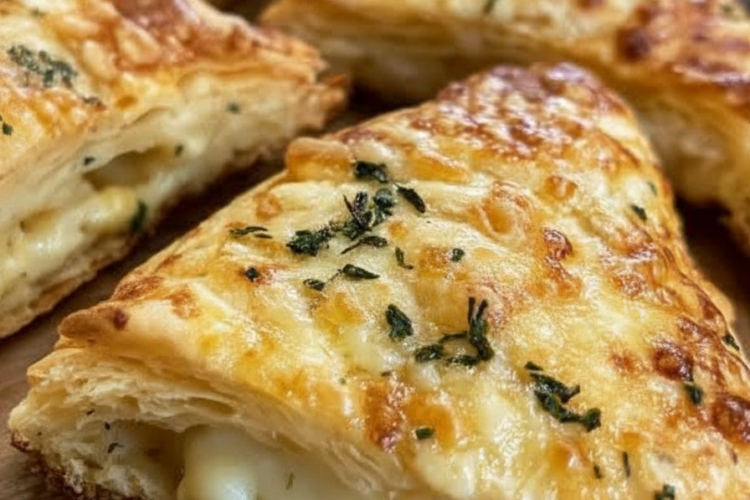
Baked Herb & Cheese Scones are a sensory delight: visually appealing with golden-brown tops glistening from egg wash, speckled with melted cheese oozing slightly at edges and vibrant green herb flecks peeking through flaky layers. Break one open, and steam rises, revealing a tender, moist crumb that’s light yet substantial, with visible strata from butter pockets.
Flavor-wise, sharp cheddar dominates with tangy, nutty depth, balanced by fresh herbs’ brightness—chives add mild onion, parsley freshness, thyme earthiness. Black pepper provides subtle warmth, while butter lends rich mouthfeel. Texture contrasts are key: crisp exterior yields to soft interior, flaky without crumbling excessively.
Aromatically, baking fills your home with cheesy, herby warmth, evoking comfort. Served warm, they’re versatile—pair with soup for dipping, salad for substance, or solo as snack. These scones transcend basic bread, offering savory elegance that’s addictive yet refined.
Nutritional Information
Per scone (based on 8 servings, approximate values using standard calculators): Calories around 250-300, primarily from butter and cheese providing energy. Total fat 15-18g (saturated 9-11g from dairy), offering richness but moderation advised. Carbohydrates 22-25g, mostly flour for sustenance, with 1g fiber.
Protein 8-10g from cheese and milk, making them satisfying. Sodium 400-500mg from salt, cheese, baking powder—mindful for low-sodium diets. Minimal sugar (under 1g naturally from milk), keeping them low-glycemic.
Vitamins include calcium (20-25% DV from cheese for bones), vitamin A from butter, traces of herbs’ antioxidants. They’re nutrient-dense in moderation: cheese supplies protein and calcium, herbs anti-inflammatory compounds, but high calories/fat suit occasional indulgence.
Compared to sweet scones, these have less sugar, more protein—healthier savory option. Pair with veggies or soup for balanced meal. Values vary by brands; consult apps for precision.
Conclusion
In wrapping up our exploration of Baked Herb & Cheese Scones, it’s clear these treats are more than a recipe—they’re a celebration of heritage, flavor, and simple joy in baking. From Scottish griddle origins to modern savory sophistication, they’ve endured by adapting while retaining flaky charm. Mastering this version brings satisfaction of creating something tender, aromatic, and versatile from pantry staples.
Whether enjoyed fresh from oven or reheated next day, these scones remind us baking fosters connection—to history, loved ones, ourselves. Their balance of indulgence and wholesomeness makes them timeless. As you bake your batch, savor process and result: golden wedges bursting with cheese and herbs, perfect for any occasion.
Recommendation
I wholeheartedly recommend trying Baked Herb & Cheese Scones soon—they’re approachable yet impressive, ideal for impressing guests or treating yourself. Start with classic recipe, then experiment with additions like bacon or garlic for personalization. Serve with tomato soup on winter evenings, as brunch base with eggs, or picnic staple.
For best experience, use quality sharp cheddar and fresh herbs—difference is profound. Pair with herbal tea or light white wine. Freeze unbaked wedges for quick future bakes. This recipe will become go-to for savory cravings.
Embracing Healthful Indulgence
Baked Herb & Cheese Scones exemplify healthful indulgence: satisfying without excess guilt, thanks to nutrient contributions from cheese (calcium, protein) and herbs (vitamins, antioxidants). In mindful eating era, they offer joy without refined sugars overload, focusing on real ingredients.
Enjoying one warm, perhaps with salad, nourishes body and soul—baking therapy reduces stress, sharing builds bonds. Balance portions, incorporate whole grains occasionally, and these scones fit wellness lifestyle. They prove indulgence and health coexist, encouraging savoring life’s flavorful moments.