Introduction
The allure of Girl Scout cookies is timeless, evoking memories of childhood, door-to-door sales, and that irresistible combination of flavors that make certain varieties stand out among the rest. Among these iconic treats, the Samoa cookie—known in some regions as Caramel deLites—holds a special place in the hearts of many dessert enthusiasts. With its buttery shortbread base, rich caramel coating, generous sprinkling of toasted coconut, and signature chocolate stripes, it offers a perfect harmony of textures and tastes: crunchy, chewy, sweet, and slightly nutty. However, the seasonal availability of official Girl Scout cookies often leaves fans yearning for more outside of the annual fundraising period. This is where the genius of no-bake copycat recipes comes into play, allowing anyone to recreate that beloved flavor profile at home with minimal effort and no oven required.
The No Bake Samoa Cookies recipe, popularized by food blogger Hayley Parker of The Domestic Rebel, simplifies the classic Samoa experience by using store-bought fudge stripe shortbread cookies as a clever base. This shortcut eliminates the need to bake a shortbread layer from scratch, cutting down preparation time dramatically while still delivering an authentic taste. In just about 30 minutes of active time, you can produce 20 to 24 indulgent treats that mimic the original’s decadent layers. The recipe relies on prepared ingredients like caramel bits and chocolate coating, making it accessible for beginners, busy parents, or anyone craving a quick dessert fix. What makes this version particularly appealing is its no-bake nature, perfect for hot summer days when turning on the oven feels unbearable, or for last-minute gatherings where time is of the essence.
Beyond mere convenience, these no-bake cookies capture the essence of indulgence without compromise. The toasted coconut adds a depth of flavor that’s subtly tropical and aromatic, the caramel provides that sticky, buttery richness, and the chocolate drizzle ties everything together with a bittersweet contrast. This homemade approach also allows for customization, portion control, and the satisfaction of creating something delicious from scratch—well, mostly. Whether you’re a die-hard Samoa fan reminiscing about cookie season or someone discovering this flavor combination for the first time, these cookies promise to deliver joy in every bite. In this comprehensive guide, we’ll explore the origins, cultural impact, ingredients, tips, step-by-step instructions, and more, to help you master this delightful treat and perhaps even make it a new tradition in your household.
Origin
The story of Samoa cookies is deeply intertwined with the broader history of Girl Scout cookies, a fundraising phenomenon that began over a century ago. The Girl Scouts organization, founded in 1912 by Juliette Gordon Low in Savannah, Georgia, sought to empower young girls through outdoor activities, leadership skills, and community service. Just five years later, in 1917, the Mistletoe Troop in Muskogee, Oklahoma, pioneered the idea of selling homemade cookies as a way to fund troop activities. This simple initiative quickly spread, and by 1922, The American Girl magazine published an official sugar cookie recipe, suggesting troops bake and sell them for 25 to 35 cents per dozen.
Initially, cookies were baked by the girls themselves or their families, but as demand grew in the 1930s, licensed commercial bakers took over production to ensure consistency and scale. By the 1950s and 1960s, varieties expanded with the post-war baby boom swelling Girl Scout ranks, introducing favorites like Thin Mints and shortbreads. The Samoa cookie specifically emerged in the 1970s, introduced around 1974-1975 by Little Brownie Bakers, one of the two primary licensed producers for Girl Scouts (the other being ABC Bakers).
The name “Samoa” is believed to draw inspiration from the exotic allure of coconut, a key ingredient, evoking images of tropical islands. Samoa, an independent nation in the South Pacific, is a major exporter of coconut products, which likely influenced the naming. Some sources suggest it reminds consumers of an “exotic island” paradise, with its caramel-dipped, coconut-rolled, chocolate-striped profile. Interestingly, the cookie is called “Caramel deLites” by ABC Bakers due to trademark differences—Little Brownie Bakers holds the rights to “Samoas.” This dual naming has caused confusion over the years, but both versions are nearly identical in flavor and appearance, with slight recipe variations between bakers.
Samoas quickly rose to become one of the top-selling varieties, second only to Thin Mints, with millions of boxes sold annually. Their introduction marked a shift toward more complex, multi-layered cookies that went beyond simple shortbreads or mints. The no-bake copycat version, like the one from The Domestic Rebel, builds on this legacy by democratizing access to the flavor. Hayley Parker’s recipe, shared in 2016, went viral for its ingenuity in using fudge-striped shortbread cookies (like Keebler’s) as the base, mimicking the chocolate-bottomed original without baking. This adaptation reflects a broader trend in home cooking where enthusiasts recreate seasonal or limited-edition treats year-round, extending the joy of Girl Scout cookies beyond fundraising season.
Cultural Significance
Girl Scout cookies, and Samoas in particular, have transcended mere snacks to become a cultural icon in American society. Each year, from January to April, the cookie sale becomes a rite of passage, teaching girls entrepreneurship, goal-setting, and financial literacy while funding troop adventures and community projects. Sales generate hundreds of millions of dollars annually, making it one of the largest girl-led business operations in the world.
Samoas embody nostalgia, often ranking high in popularity polls for their unique tropical twist amid more straightforward chocolate or peanut butter options. They evoke memories of childhood purchases outside supermarkets, workplace orders, or freezer stashes to prolong the season. Culturally, they’ve inspired countless copycats, from store-brand knockoffs to limited-edition cereals and ice creams. The cookie’s purple box and vibrant imagery reinforce themes of adventure and empowerment.
The dual naming—Samoas versus Caramel deLites—has sparked friendly debates and regional loyalties, highlighting how food can reflect geographic divides. Despite rumors of name changes due to cultural sensitivity, the variation stems purely from bakery trademarks, not controversy.
In broader pop culture, Samoas represent indulgence with a purpose: supporting youth development. They’ve appeared in media, memes, and even “cookiecotts” misinformation campaigns, underscoring their entrenched status. For many, biting into a Samoa (or its homemade counterpart) is a momentary escape, blending comfort with exotic flair.
The no-bake version amplifies this significance by empowering home cooks to reclaim the flavor anytime, fostering creativity and family bonding in the kitchen.
Ingredients Quantity
To make 20-24 No Bake Samoa Cookies, gather these precise ingredients as outlined in the original recipe by Hayley Parker:
- 1 package fudge stripe shortbread cookies (approximately 20-24 cookies, such as Keebler Fudge Stripes, providing the chocolate-bottomed base).
- 1 (11 oz) package caramel bits (like Kraft Caramel Bits, for easy melting without unwrapping individual caramels).
- 3 tablespoons heavy cream (essential for smoothing the caramel into a spreadable consistency).
- 2 cups toasted coconut (unsweetened shredded coconut, toasted for enhanced nutty flavor; instructions provided below).
- 2 squares chocolate CandiQuik or equivalent candy coating (about 8 oz total, for drizzling; alternatives like almond bark or melted chocolate chips work).
These quantities yield perfectly portioned cookies, with each receiving a generous topping of caramel-coconut mixture and chocolate drizzle. Scaling up is straightforward—double for larger batches.
Optional Additions
While the core recipe is perfection in simplicity, optional additions can elevate or personalize these cookies. Consider adding a pinch of sea salt to the caramel mixture for salted caramel notes, enhancing sweetness contrast. For extra crunch, mix in chopped pecans or almonds with the toasted coconut. For a boozy twist, stir a teaspoon of rum extract into the caramel. Healthier spins might include dark chocolate (70%+ cacao) or reducing caramel slightly.
Some variations from similar recipes suggest dipping the entire base in chocolate first or using butterscotch chips for deeper caramel flavor. Experiment with flavored shortbread bases if available. Vegan adaptations: use coconut cream instead of heavy cream, dairy-free caramel, and vegan chocolate.
Tips for Success
Success with this no-bake recipe hinges on a few key practices. First, toast the coconut carefully—spread evenly, watch closely to avoid burning, stirring frequently for uniform golden color. This step intensifies flavor immensely.
Work quickly once the caramel is melted, as it sets fast; have cookies lined up and ready. Use a foil-lined baking sheet for easy cleanup and transfer. For neat drizzles, employ a ziplock bag as a piping tool by snipping a tiny corner—precise and mess-free.
Let cookies set fully (15-20 minutes) at room temperature or refrigerate briefly for faster results. Store airtight to maintain freshness up to a week. If caramel seizes, add more cream sparingly.
Common pitfalls: over-toasting coconut (bitter taste) or uneven spreading (lopsided cookies). Practice on a few first.
Instructions
Follow these detailed steps for flawless results:
- Prepare your workspace: Line a large baking sheet with foil or parchment for easy release. Arrange the fudge stripe shortbread cookies stripe-side up, spaced 1-2 inches apart.
- Toast the coconut if not pre-toasted: Spread 2 cups shredded coconut evenly on a foil-lined pan. Bake at 300°F for 5 minutes, stir, then 5-7 more minutes, stirring again, and finally 3-5 minutes until golden. Watch vigilantly to prevent burning; cool completely.
- Melt the caramel: In a microwave-safe bowl, combine the 11 oz caramel bits and 3 Tbsp heavy cream. Microwave on high for 30 seconds, stir thoroughly, then 15-20 more seconds until smooth and fully melted.
- Incorporate coconut: Fold the toasted coconut into the melted caramel until evenly coated, creating a thick, spreadable mixture.
- Top the cookies: Working swiftly (caramel sets quickly), drop heaping tablespoonfuls of the coconut-caramel onto each cookie center. Use the spoon back to gently spread to the edges, covering the top surface completely. Repeat for all cookies.
- Drizzle chocolate: Melt the 2 squares of CandiQuik in a microwave-safe bowl on high for 30 seconds, stirring until smooth. Transfer to a ziplock bag, seal, snip a small corner, and drizzle decoratively over each topped cookie.
- Set and store: Allow cookies to set at room temperature for 15-20 minutes until chocolate hardens. Store in an airtight container at room temperature.
These steps ensure professional-looking results with minimal fuss.
Description
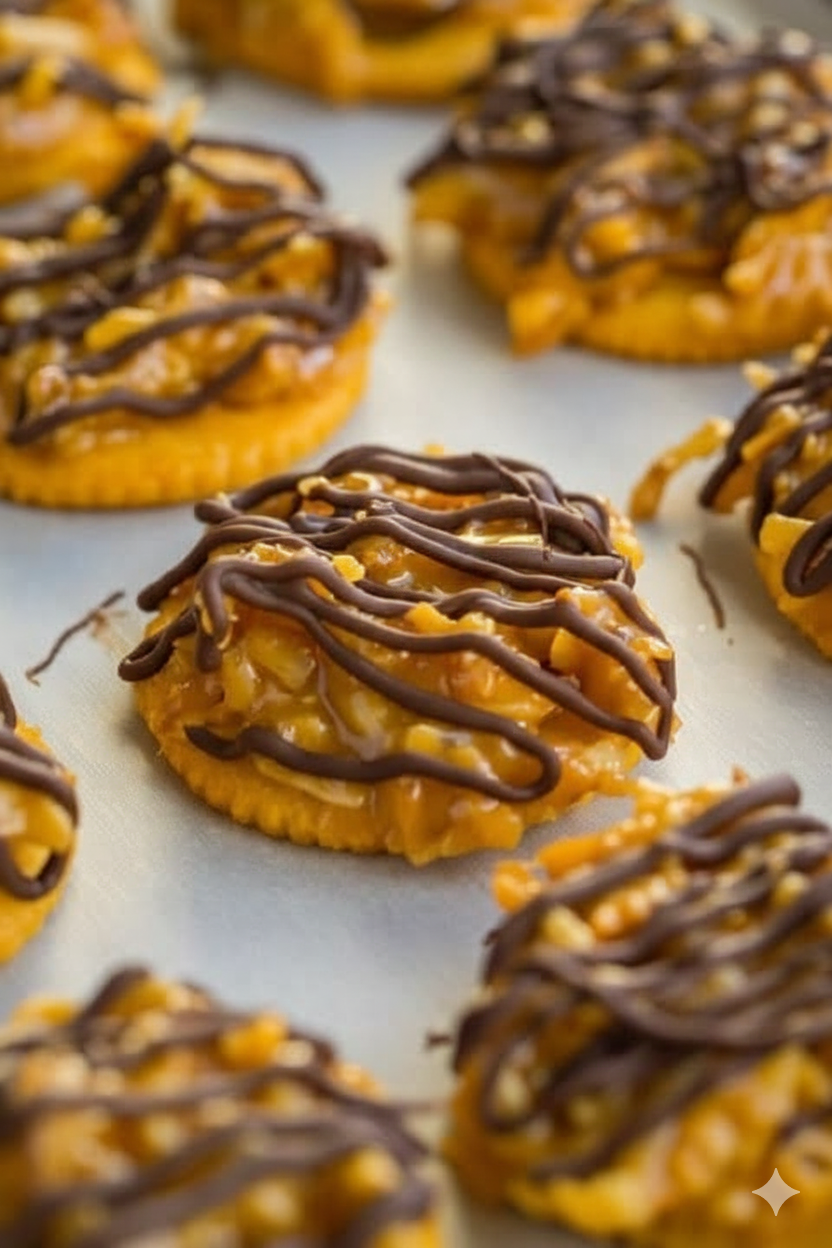
These No Bake Samoa Cookies are a visual and sensory delight. Each starts with a crisp, buttery shortbread cookie bottomed in rich fudge stripes, providing instant chocolate satisfaction. Atop sits a generous mound of chewy caramel infused with golden-toasted coconut, offering nutty aroma and textural contrast—crunchy flakes against sticky sweetness.
The finishing chocolate drizzle adds glossy stripes, mimicking the original’s iconic look while contributing bittersweet depth. Biting in reveals layers: initial snap from shortbread, yielding to gooey caramel-coconut, ending with chocolate melt. Flavors balance perfectly—sweet caramel, tropical coconut, buttery base, dark chocolate edge—creating an addictive treat that’s indulgent yet portion-controlled.
Compared to originals, they’re slightly larger and more generous in topping, often fresher-tasting.
Nutritional Information
Per cookie (approximate, based on 22 servings and similar to original Samoas):
- Calories: 140-160
- Total Fat: 8-10g (mostly from coconut and chocolate)
- Saturated Fat: 6-7g
- Carbohydrates: 18-20g
- Sugars: 12-14g
- Protein: 1-2g
Toasted coconut offers fiber and healthy fats (MCTs for energy), dark chocolate provides antioxidants, but overall, these are a treat high in sugar and calories. Enjoy mindfully; moderation allows healthful indulgence.
Conclusion
In wrapping up, No Bake Samoa Cookies offer a brilliant bridge between nostalgia and convenience, faithfully recreating a cultural favorite without the wait or oven heat. From their 1970s origins to modern home adaptations, they’ve proven enduringly popular for good reason.
This recipe not only satisfies cravings but invites creativity and sharing, turning simple ingredients into memorable moments.
Recommendation
I highly recommend trying this recipe soon—perfect for parties, gifts, or personal indulgence. Pair with milk or coffee for ultimate enjoyment. If you love the original, you’ll adore this effortless version.
Embracing Healthful Indulgence
While decadent, these cookies can fit into a balanced lifestyle when enjoyed occasionally. Focus on quality ingredients: opt for high-cacao chocolate for antioxidants, natural caramel if possible, and savor slowly. Toasted coconut provides beneficial fats supporting metabolism, and portion size aids control.
Indulgence isn’t about deprivation but mindful pleasure—these cookies embody that, reminding us treats enhance life’s sweetness when embraced thoughtfully. Make a batch, share with loved ones, and celebrate the joy of homemade delights