Introduction
The holiday season brings a cascade of cherished traditions, from twinkling lights on evergreen trees to the warm glow of family gatherings around a crackling fire, and among these, few treats evoke as much nostalgia and joy as Chewy Christmas Peppermints. These soft, melt-in-your-mouth candies, with their iconic red-and-white swirls reminiscent of classic candy canes, are a staple in many homes during December. Unlike their hard, crunchy counterparts, these chewy mints offer a creamy, buttery texture that dissolves slowly on the tongue, releasing a refreshing burst of peppermint flavor that perfectly captures the essence of winter festivities. This homemade version elevates the simple pleasure of store-bought pillow mints or dinner mints into something truly special, crafted with love in your own kitchen.
Making Chewy Christmas Peppermints is not just about creating a delicious confection; it’s about embracing the spirit of the season through hands-on creativity that can involve the whole family. Children delight in twisting the colored ropes together, while adults appreciate the therapeutic rhythm of rolling and shaping. These mints make wonderful gifts, neatly packaged in festive tins or jars, or they can adorn holiday dessert tables alongside cookies and fudge. With a recipe that yields dozens of pieces from just a few basic ingredients, they’re economical yet impressive, allowing you to share the magic of homemade treats without overwhelming effort.
In this comprehensive guide, we’ll explore every facet of these delightful Chewy Christmas Peppermints, from their fascinating historical roots to practical tips for perfect results. Whether you’re a seasoned baker or a novice in the kitchen, this post will equip you with everything needed to create batches that will become a new holiday tradition in your home. Let’s dive into the world of these swirled wonders and discover why they deserve a place in your Christmas celebrations.
Origin
The story of peppermint candies, particularly those associated with Christmas, is steeped in folklore, innovation, and cultural evolution, tracing back centuries across Europe and eventually blooming in America. While the exact origins of twisted peppermint treats remain somewhat legendary, the most enduring tale points to 17th-century Germany, where a choirmaster at Cologne Cathedral reportedly commissioned straight white sugar sticks from a local candymaker in 1670. These were intended to keep children quiet during long Christmas Eve services, with the hook shape added later to symbolize shepherds’ crooks from the Nativity story. Though this account is debated by historians as potentially apocryphal, it highlights how peppermint candies became intertwined with religious and festive observances.
Peppermint itself, a hybrid of watermint and spearmint, has ancient roots in the Mediterranean, praised by the Romans and Egyptians for its digestive and refreshing properties. By the 18th and 19th centuries, it was cultivated commercially in Europe and used in lozenges and candies. The addition of peppermint flavor to sugar sticks likely emerged in the 19th century, with recipes for striped peppermint candies appearing in cookbooks like “The Complete Confectioner” in 1844. Early candy canes were straight and white, but by the mid-1800s, references to twisted, striped versions hung on Christmas trees began appearing in American literature and immigrant traditions, brought by German settlers.
The iconic red-and-white stripes and widespread popularity surged in the early 20th century. In 1847, a German-Swedish immigrant named August Imgard decorated the first known American Christmas tree with candy canes in Ohio, sparking a trend. Mass production took off in the 1950s when Bob McCormack’s company in Georgia, aided by his brother-in-law Gregory Keller’s invention of an automated twisting machine (patented in 1957), made candy canes affordable and abundant. This automation transformed them from labor-intensive novelties into holiday staples. Soft, chewy versions like our butter-based mints evolved from “pillow mints” or “butter mints,” popular at weddings and dinners since the early 1900s, adapting the classic peppermint twist for a creamier texture.
Today, these chewy twisted peppermints bridge old-world folklore with modern homemade charm, reminding us how simple sugar and flavoring have become symbols of holiday cheer across generations.
Cultural Significance
Peppermint candies hold a special place in Christmas culture worldwide, symbolizing more than just sweetness—they embody refreshment, purity, and festivity. The red-and-white colors evoke the holiday palette, with white often representing purity and red signifying joy or sacrifice in Christian symbolism, though these interpretations arose later to explain the design. In many families, hanging candy canes on trees or filling stockings with peppermints is a ritual passed down, connecting children to ancestors’ celebrations.
Culturally, peppermint’s cooling sensation contrasts beautifully with winter’s chill, providing a sensory burst that enhances hot cocoa or after-dinner moments. In America, they’re tied to Victorian-era tree decorations and 20th-century commercialization, becoming the top non-chocolate holiday candy. Globally, similar treats appear in European markets and Scandinavian polkagris (striped peppermint sticks). These mints also feature in media, from songs like “Peppermint Winter” to films depicting snowy scenes with candy canes.
For many, making or sharing chewy peppermints fosters community—gifted to neighbors, served at parties, or used in advent calendars. They represent indulgence tempered with lightness, perfect for a season of abundance. In a fast-paced world, crafting them at home revives mindful traditions, turning simple ingredients into meaningful memories.
Ingredients Quantity
To make approximately 100-150 small Chewy Christmas Peppermints, you’ll need the following precise quantities:
- Butter, softened – 1/2 cup (1 stick or 113 grams). Use unsalted for control over flavor, or salted for a subtle contrast.
- Powdered sugar – 3 cups (about 360-375 grams). This provides the structure and sweetness; sift if lumpy for smoothness.
- Heavy whipping cream – 2 tablespoons (30 ml). This adds creaminess and helps achieve the chewy texture without making the dough too stiff.
- Peppermint extract – 1/4 teaspoon (adjust up to 1/2 teaspoon for stronger flavor). Pure extract is key for authentic taste; avoid imitation for best results.
- Red gel food coloring – as needed (a few drops to a toothpick dab). Gel provides vibrant color without thinning the dough, unlike liquid coloring.
These quantities yield a dough that’s firm yet pliable, perfect for twisting and shaping into bite-sized pieces.
Optional Additions
While the classic recipe shines in its simplicity, optional additions can customize your Chewy Christmas Peppermints:
- Increase peppermint extract to 1/2 teaspoon for bolder flavor.
- Add a pinch of salt to enhance sweetness.
- Incorporate 1/8 teaspoon vanilla extract for depth.
- For variety, divide dough and use green coloring for some portions, creating festive tri-color twists.
- Dust finished mints with extra powdered sugar for a snowy effect or to prevent sticking.
- Experiment with other extracts like wintergreen or spearmint, though peppermint remains traditional.
These tweaks allow personalization while preserving the core holiday appeal.
Tips for Success
Achieving perfect Chewy Christmas Peppermints requires attention to a few key details that can make or break the texture and appearance.
First, ensure your butter is truly softened—room temperature for about 30-60 minutes—but not melted, as this affects dough firmness. Beat it thoroughly until light and fluffy for an airy final product. When adding powdered sugar, do so gradually to avoid a cloud of dust and ensure even incorporation; the dough should pull away from the bowl sides cleanly.
Humidity plays a big role: in dry environments, you may need an extra drop of cream; in humid ones, add more powdered sugar sparingly. Work quickly during twisting, as the dough can soften at room temperature—chill briefly if needed. For clean twists, roll ropes on a lightly powdered surface to prevent sticking, aiming for uniform thickness (about pencil-thin) for even drying.
Drying is crucial: the initial 1-2 hours sets the shape, while the full 24 hours develops the signature chewy-yet-firm texture. Store in a cool, dry place; airtight containers prevent softening. If mints are too soft, extend drying time; if too hard, reduce it slightly next batch. Finally, involve helpers for twisting—it’s fun and speeds the process!
With these tips, your mints will turn out beautifully every time.
Instructions
Follow these detailed steps to create your Chewy Christmas Peppermints:
Step 1: Beat the Butter. In a large mixing bowl or stand mixer fitted with a paddle attachment, beat the 1/2 cup softened butter on medium speed for 2-3 minutes until it becomes light, fluffy, and pale in color. This incorporates air for a creamy texture.
Step 2: Add Remaining Ingredients. With the mixer on low, slowly add the 2 tablespoons heavy whipping cream, followed by the 3 cups powdered sugar (one cup at a time) and 1/4 teaspoon peppermint extract. Increase speed to medium and beat for 3-5 minutes until the mixture forms a smooth, firm dough that holds together without being crumbly or sticky. If too dry, add cream drop by drop; if too wet, add powdered sugar by tablespoons.
Step 3: Separate and Color. Divide the dough into two portions: about 3/4 for white and 1/4 for red. To the smaller portion, add red gel food coloring a little at a time, kneading by hand (wear gloves to avoid staining) until you achieve a vibrant holiday red. Leave the larger portion plain white.
Step 4: Roll and Twist. On a surface lightly dusted with powdered sugar, roll small portions (walnut-sized) of each color into long, thin ropes about 1/4-inch thick and 12-18 inches long. Gently twist one red and one white rope together, pressing lightly to adhere. Pinch off small sections (1-2 inches) or roll the entire twisted rope and cut into pieces for uniform mints. For classic pillow shapes, flatten slightly or curve into canes.
Step 5: Dry and Set. Place the shaped mints on parchment-lined baking sheets, spaced apart. Allow to air dry at room temperature for 1-2 hours to firm up the exterior. Then, let them dry fully for 24 hours (or up to 48 in humid conditions) uncovered or loosely covered. Once set, they should be chewy inside with a slight crust outside. Store in airtight containers for up to 2 weeks.
Enjoy the process—it’s as rewarding as the tasting!
Description
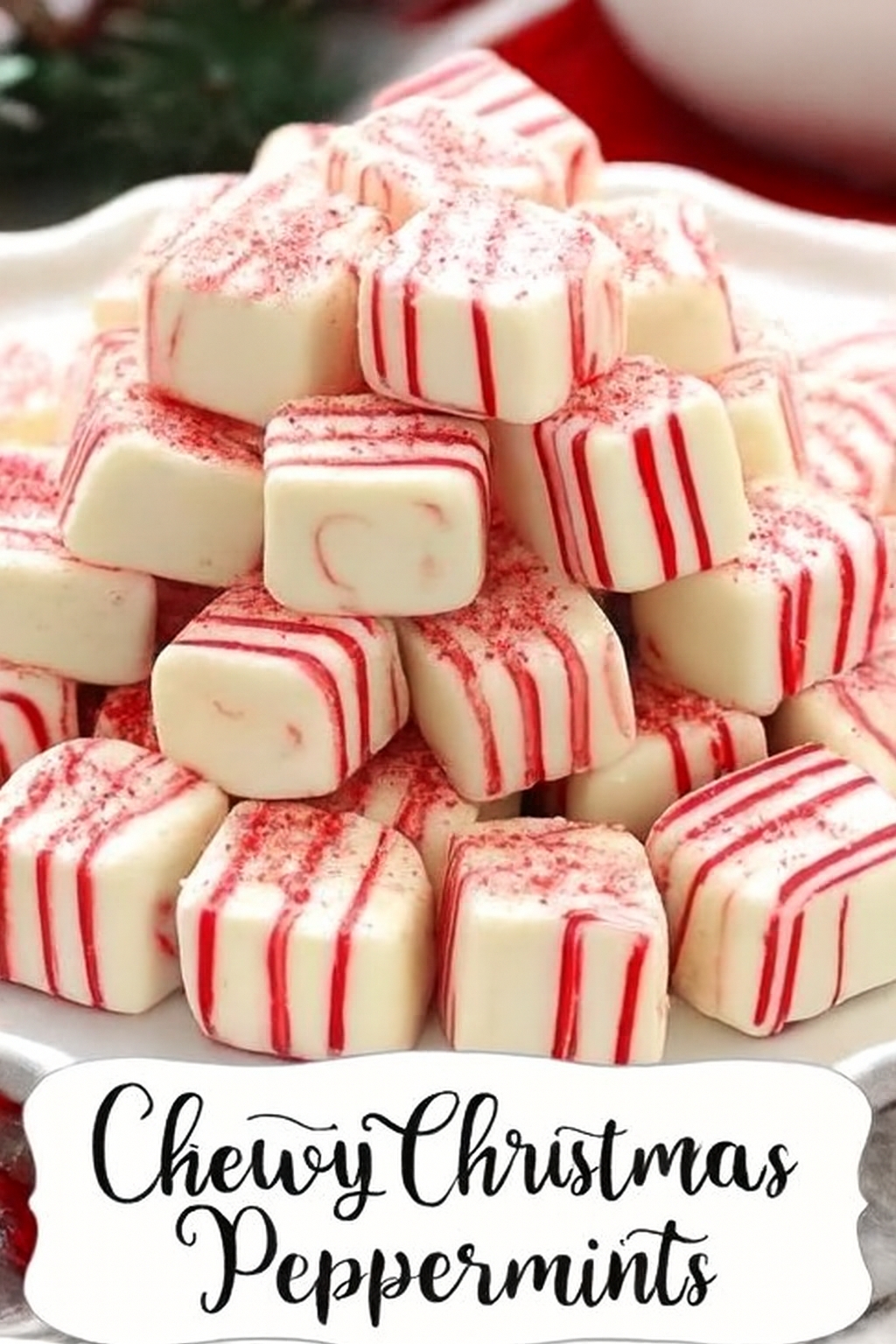
Chewy Christmas Peppermints are a sensory delight: visually striking with their candy cane-inspired red-and-white spirals, they immediately evoke holiday cheer. The texture is uniquely appealing—soft and pliable when fresh, developing a creamy chew that melts slowly, coating the mouth with buttery richness. The flavor profile is dominated by cool, invigorating peppermint that starts subtle and builds to a refreshing finish, balanced by the sweet powdered sugar and subtle dairy notes from butter and cream.
Each bite-sized piece (about 1 inch) offers a satisfying snap if slightly dried on the outside, giving way to a pillow-like interior that’s far superior to commercial hard mints. They’re not overly sweet, making them ideal for nibbling throughout the day or as palate cleansers after rich meals. Served on a festive platter, they sparkle under lights, adding elegance to cookie exchanges or gift baskets. Overall, these mints embody comforting indulgence—nostalgic yet sophisticated.
Nutritional Information
Homemade Chewy Christmas Peppermints are a treat best enjoyed in moderation due to their sugar and fat content. Approximate values per serving (5 small mints, about 25g total, based on similar butter mint recipes):
- Calories: 300-310 kcal (primarily from sugar and butter).
- Carbohydrates: 50g (almost entirely sugars).
- Fat: 10-12g (Saturated Fat: 7-8g).
- Protein: 0g.
- Cholesterol: 30-35mg.
- Sodium: 40-50mg.
- No significant vitamins or minerals, though peppermint may aid minor digestion.
These figures vary slightly with exact measurements and drying time. They’re gluten-free but high in calories—perfect for occasional holiday enjoyment.
Conclusion
As we wrap up this journey through Chewy Christmas Peppermints, it’s clear why they’ve endured as a beloved treat: they combine simplicity, beauty, and flavor in a way that enhances any celebration. From their legendary origins to the joy of crafting them today, these mints remind us of the magic in small, handmade gestures.
Whether shared with loved ones or savored alone by the fireside, they encapsulate the warmth of the season. This recipe invites you to create lasting memories while producing dozens of delightful candies.
Recommendation
I highly recommend making a double batch of Chewy Christmas Peppermints this year—they’re easy, affordable, and infinitely customizable. Package them in clear cellophane bags tied with ribbon for thoughtful gifts, or arrange on tiered stands for parties. Pair with hot chocolate or coffee for ultimate coziness. Once you try homemade, store-bought won’t compare!
Embracing Healthful Indulgence
While Chewy Christmas Peppermints are undeniably indulgent, embracing them mindfully adds to their charm. Enjoy a few as a reward after a winter walk, or share to spread joy without overdoing. Peppermint’s natural cooling can refresh, and the act of making them promotes relaxation—a healthful balance in a busy season. Savor the sweetness, cherish the tradition, and indulge with gratitude.